Our client was facing low traffic to their newly launched product. Despite investing in marketing efforts, our client was struggling to generate organic traffic and gain visibility in their target market. They recognized the importance of organic traffic for sustainable growth and sought assistance to improve their online presence. Through our time-tested strategies for amplifying organic traffic, we seamlessly assisted our client in reaching their goals!
Implementation
The Expert Community collaborated closely with the client, crafting a comprehensive content and SEO strategy.
To address the client’s challenge, we conducted a comprehensive analysis of current digital marketing strategy. Our team identified several areas that required improvement, including search engine optimization and content marketing.
We developed a tailored solution that involved the following key steps:
1. Keyword Research: We conducted extensive keyword research to identify relevant and high-volume keywords within the client’s industry. This allowed us to optimize their website content and improve their search engine rankings.
2. On-Page Optimization: We implemented on-page optimization techniques, including optimizing meta tags, headings, and URLs, to ensure that the client’s website was search engine friendly and easily discoverable by potential customers.
3. Content Strategy: We developed a content strategy focused on creating informative and engaging content that resonated with the target audience. This involved writing blog posts, articles, and whitepapers that addressed common pain points and provided valuable insights.
4. Link Building: To boost the client’s online authority and improve their search engine rankings, we implemented a strategic link building campaign. This involved reaching out to relevant influencers, industry publications, and bloggers to secure high-quality back links to the client’s website.
5. Social Media Marketing: We leveraged social media platforms to increase brand awareness and drive targeted traffic to the client’s website. Through strategic content creation and engagement, we built a loyal following of potential customers interested in the client’s products.
6. Monitoring and Analysis: Throughout the campaign, we closely monitored the performance of our digital marketing efforts. We analyzed key metrics such as organic traffic, keyword rankings, and engagement levels to optimize our strategies and achieve the best results.
The Results
“The product gained momentum swiftly, attracting a surge of organic traffic, and emerged as a game-changing success!”
1. Traffic Growth: Within 6 months of implementing our organic traffic cultivation strategies, the client experienced a surprising increase in organic traffic to their product. This translated into a significant boost in visibility and exposure to their target market.
2. Improved Rankings: Our SEO efforts resulted in the client’s website ranking on the first page of search engine results for several high-value keywords. This increased their organic visibility and brought in targeted traffic actively searching for their products.
3. Positive Customer Feedback: We received glowing feedback from the client’s customers, who appreciated the informative and valuable content we provided. Testimonials highlighted the positive impact of our strategies and conveyed a strong sense of trust and credibility in the client’s brand.
Conclusion
“Where Every Story Finds Its Happy Ending!”
The client’s transformation from struggling with minimal website visitors to achieving astonishing organic growth tells a remarkable story of how a tailored and all-encompassing digital marketing strategy can work wonders. We blended powerful SEO tactics, captivating content crafting, and smart link-building strategies, resulting in a flourishing stream of organic traffic that propelled the client towards their business aspirations.
Our efforts and expertise isn’t just about theories; it’s a proven example of how our solution creates tangible impacts. It underscores our proficiency in boosting organic traffic, a crucial skill for successful product launches in today’s digital age.
By joining forces with us, businesses can tap into their full potential and experience sustainable growth in the dynamic digital landscape.
Businesses are constantly seeking new ways to stay competitive, improve efficiency, and drive growth. One technology that has emerged as a game-changer in achieving these goals is Artificial Intelligence (AI). AI for business automation is reshaping industries and offering a pathway to success that was previously unimaginable.
In this article, we will explore the profound impact of AI on industries and how it can be the key to thriving in the digital age.
What is Artificial Intelligence (AI)?
AI refers to the simulation of human intelligence processes by machines, especially computer systems. This includes learning, reasoning, problem-solving, perception, and language understanding. It’s a fascinating and rapidly evolving field, and it’s here to stay, making our world smarter and more connected.
Moreover, In the landscape of business, many examples of AI can be harnessed to automate various tasks and processes, making operations more efficient, accurate, and cost-effective.
What is the Role of AI in Business?
Before delving deeper into the advantages and applications of AI in business automation, it’s crucial to understand what AI is and how it works in a business context.
Enhancing Decision-Making
One of the most significant ways AI contributes to business automation is by augmenting decision-making processes. AI algorithms can analyze vast datasets in real-time, identifying trends and patterns that humans might overlook.
This data-driven decision-making allows businesses to make informed choices, from inventory management to marketing strategies.
For instance, e-commerce giants utilize AI to optimize pricing dynamically, taking into account competitor prices, demand, and historical data. This not only boosts profitability but also ensures customers receive competitive prices.
Furthermore, consultancy and accounting service providers are reaping benefits on extreme level.
Streamlining Operations
Automation is synonymous with efficiency, and AI takes automation to the next level. Repetitive and time-consuming tasks can be seamlessly automated, freeing up human resources for more strategic and creative endeavors.
For instance, chatbots powered by AI can handle customer inquiries 24/7, significantly improving customer service without requiring additional human staff.
Personalizing Customer Experiences
In the digital age, customer experience is paramount. AI can analyze customer behavior and preferences to create highly personalized interactions. AI are also used to recommend movies and TV shows based on a user’s viewing history and preferences. This not only keeps customers engaged but also increases the likelihood of retention and up-selling.
Predictive Maintenance
In manufacturing and logistics, AI can predict when equipment is likely to fail based on sensor data and historical performance. This allows businesses to perform maintenance proactively, reducing downtime and avoiding costly breakdowns.
Risk Management
AI-powered analytics can assess and mitigate risks in real-time. Financial services use AI to detect fraudulent transactions and identify potential credit risks. This proactive approach safeguards both the business and its customers.
What are the Examples of AI in business?
AI is rapidly transforming businesses across all industries, from streamlining operations to boosting sales and enhancing customer experiences. Here are a few examples of how AI is making waves in the business world:
1. Customer Service and Support
Chatbots and virtual assistants: These AI-powered tools can handle basic inquiries, freeing up human agents for more complex issues. This 24/7 availability improves customer satisfaction and reduces costs.
Sentiment analysis: AI can analyze customer feedback to identify positive and negative trends, helping businesses understand customer needs and improve their products and services.
2. Marketing and Sales
Personalized recommendations: AI can analyze customer data to recommend products or services that are likely to interest them, leading to increased sales and customer engagement.
Targeted advertising: AI can help businesses target their advertising campaigns to the right audience, maximizing their return on investment.
3. Operations and Logistics
Predictive maintenance: AI can analyze sensor data from equipment to predict when it is likely to fail, allowing businesses to schedule maintenance before breakdowns occur. This reduces downtime and saves costs.
Supply chain optimization: AI can help businesses optimize their supply chains by predicting demand, routing shipments, and managing inventory levels.
4. Finance and Risk Management
Fraud detection: AI can analyze financial transactions to identify fraudulent activity in real-time, protecting businesses from financial losses.
Risk assessment: AI can analyze data to assess the risk of lending money to borrowers or insuring properties.
These are just a few examples of how AI is being used in business. As AI technology continues to evolve, we can expect to see even more innovative applications in the years to come.
What are the Benefits of using AI in Business?
So, many industries are enjoying the perks of collaboration with artificial intelligence and benefiting from these below-mentioned advantages, boosting sales and customer experience.
Increased Efficiency- Imagine if you could magically free up hours in your workday. That’s what AI and automation do for businesses. They take care of repetitive tasks, so you and your team can focus on more meaningful work.
Improved Accuracy: Let’s face it; we’re all prone to errors now and then. But machines? They’re precise. Using AI can reduce mistakes and costly rework, making your operations smoother and more reliable.
Happier Employees: When your team doesn’t have to spend endless hours on mind-numbing tasks, they can do what they’re best at—creative thinking, problem-solving, and making strategic decisions. This boosts morale and job satisfaction.
Always On: Automation doesn’t need a coffee break, vacation, or a good night’s sleep. It works 24/7, ensuring your important processes run smoothly even when everyone else is resting.
Money Saver: Less manual labor means lower labor costs. Plus, fewer errors and better efficiency can save you money in the long run.
Lightning-Fast Decisions: AI can analyze mountains of data in a blink of an eye, helping you make decisions faster. In business, speed often translates to staying ahead of the competition.
Ready for Growth: As your business grows, AI and automation can grow with you. They’re scalable, so you won’t need to reinvent the wheel as your company expands.
Reduced Risk: AI can help detect potential problems before they become major headaches. Whether it’s spotting fraudulent activity or predicting equipment failures, it has your back!
Data Insights: Ever wish you had a crystal ball to see where your business is headed? AI can’t predict the future, but it can uncover valuable insights from your data, helping you make informed decisions.
Competitive Edge: Being an early adopter of AI can put you ahead of the competition. You can offer better products or services at lower costs, which can attract more customers and boost revenue.
How can AI be implemented into a Business?
Absolutely, let’s explore how you can bring the magic of AI into your consulting business or any other industry to make things more efficient and exciting!
Step 1: Identify Your Automation Goals
Think about what tasks in your business are repetitive, time-consuming, or prone to errors. These are the perfect innovations for automation. Whether it’s managing customer inquiries, processing invoices, or analyzing data, it can handle it.
Step 2: Choose the Right AI Tools
There’s a whole toolbox of AI options out there. You might consider chatbots for customer service, machine learning algorithms for data analysis, or even robotic process automation (RPA) for handling routine office tasks. Pick the tools that fit your needs!
Step 3: Gather the Data
AI loves data! You’ll need to gather the relevant information that your AI tools can learn from. This might be customer data, inventory records, or anything else related to the tasks you want to automate.
Step 4: Train Your AI
Now comes the fun part – training your AI. Think of it like teaching a pet some tricks, except your pet is a computer program. You’ll feed your AI lots of data, and it will learn to perform tasks based on that data.
Step 5: Test and Refine
Next, your AI might not get everything perfect right away, just like how you wouldn’t expect a new employee to know everything on their first day. Therefore, test your AI’s performance, and keep fine-tuning it until it works like a well-oiled machine.
Step 6: Integrate and Collaborate
AI isn’t here to replace humans; it’s here to make our lives easier. Integrate your AI into your existing workflows so that it can work alongside your team. Collaboration is key!
Step 7: Monitor and Maintain
Just like you’d take care of a garden to keep it thriving, you’ll need to monitor and maintain your AI systems. Check in regularly to make sure everything’s running smoothly and update your AI as needed.
Hence, go ahead and bring a little bit of the future into your business – it’s bound to be an exciting journey!
Winding Up!
In the digital age, AI in business automation is no longer a luxury but a necessity. It empowers organizations to make data-driven decisions, streamline operations, personalize customer experiences, and mitigate risks. To remain competitive in the digital age, businesses must embrace AI and carefully plan its implementation.
And to make your dream true, we at The Expert Community offer highly advanced AI and automation services and solutions. We can help you remain on top of the competition with our seamless technologies. Even many businesses have already seen how it can impact their growth. Now, it’s your time to enter into the world of AI technologies.
Remember, those who adapt and innovate with AI will be the ones best positioned for success in the dynamic landscape of the digital age. Contact us now!
Want to eliminate bottlenecks, boost profit, and deliver better service? Outsourcing has become a strategic tool for companies looking to streamline such operations. Every business process outsourcing company play a pivotal role in this landscape. They handle various non-core functions, allowing businesses to operate more efficiently.
And, choosing the right BPO partner is critical. So, to ease your burden, we thought to make your search easier & effective. We thought to craft the most helpful guide to assist you to choose the right option.
Scroll down to read the complete article…
What is Business Process Outsourcing Company?
A business process outsourcing (BPO) firm is a company that provides specialized services to other businesses by taking over some of their operational functions. These functions can range from basic tasks like data entry and customer service to more complex processes like IT support and financial accounting.
Here’s a breakdown of what BPO firms offer:
What They Do?
Perform specific business functions: BPO firms specialize in handling specific tasks, allowing businesses to focus on their core competencies.
Provide expertise and resources: Business process outsourcing company possess skilled personnel and resources that might not be readily available or affordable for smaller businesses.
Offer cost savings: By outsourcing non-core functions, businesses can potentially reduce their operational costs.
Improve efficiency and productivity: BPO firms typically have well-defined processes and systems, leading to increased efficiency and productivity for the client company
Types of BPO Services
Front-office BPO: These BPO services focus on customer-facing activities like customer service, sales, and marketing.
Back-office BPO: Such BPO services include internal business functions like finance and accounting, human resources, and IT support.
Knowledge process outsourcing (KPO): This involves outsourcing knowledge-intensive processes like legal research, medical transcription, and engineering design.
Benefits of Using BPO Firms
Cost savings: Business process outsourcing company can offer significant cost savings compared to hiring and managing in-house employees. Increased efficiency: BPO firms can improve efficiency and productivity through their specialized processes and resources. Focus on core competencies: By outsourcing non-core functions, businesses can free up resources to focus on their core strengths. Access to expertise: Business process outsourcing company have access to specialized skills and expertise that might not be available in-house. Scalability: BPO services can be easily scaled up or down to meet changing business needs.
Here are 6 essential things to look for in a great BPO company…!!!
1. Track Record and Reputation
Partnering with a BPO firm that has been in business for an extended period of time has its perks. It shows they have a proven model, they are stable, and they have satisfied customers. While you should still do your research and make sure they have a solid reputation, longevity gives you a quick snapshot of their capabilities. So, go ahead and check how long they’ve been around before making any decisions.
2. Industry-Specific Experience
When choosing a business process outsourcing company, it’s crucial to consider their industry-specific experience. Each industry has its own unique challenges and requirements, from healthcare to finance. You want to work with a BPO firm that understands the regulatory concerns, market dynamics, and customer expectations specific to your industry.
Don’t settle for a one-size-fits-all approach. Look for a BPO firm that takes the time to understand your organization’s vision, culture, and objectives, and provides tailored strategies that truly fit your interests.
3. Tailored Strategies
When it comes to solving business challenges, one-size-fits-all models just won’t cut it. Your BPO firm should take a genuine interest in your organization – your vision, culture, objectives, and all the little details that make you unique.
Instead of offering cookie-cutter solutions, they should sit down with you, gather firsthand information about your processes and challenges, and then provide you with tailored BPO strategies that perfectly fit your needs. After all, who doesn’t love a little customization in their outsourcing experience?
4. Robust Technological Solutions
When it comes to choosing a business process outsourcing company, you need to make sure they have robust technological solutions. Why? Because automation is all the rage these days, and you don’t want to be left in the Stone Age.
Picture this: you have 250 documents that need to be scanned per minute, with data extracted and uploaded automatically. Sounds pretty amazing, right? Well, not every BPO firm invests in the right tech or knows how to leverage it effectively.
So, make sure your chosen BPO can handle tech from all angles, whether it’s scanning documents or overcoming interoperability challenges. Don’t settle for less than the best tech, my friend.
5. The Right People
Ah, the human element. No matter how shiny and impressive the technology is, you can’t underestimate the power of good ol’ human beings. When choosing a business process outsourcing company, it’s crucial to ensure they have the right people in place. And by right people, I mean professionals who know their stuff and won’t leave you hanging.
Imagine this scenario: you reach out to the BPO firm with a burning question or concern, and instead of getting a helpful response, you end up in a never-ending game of phone tag or email ping-pong. Yeah, not a pleasant picture, right? You need a BPO partner who is quick to respond and provides effective solutions.
6. Pressure Handling and Quality Results
We all know that work can get overwhelming, and sometimes you feel like you’re drowning in a sea of tasks. This is where the BPO’s ability to handle pressure with ease and wit comes into play. You want a team of professionals who won’t crack under pressure but will rise to the occasion and deliver outstanding results.
But wait, there’s more! The whole reason you’re outsourcing in the first place is to get high-quality work, right? Of course! So, make sure your chosen business process outsourcing company has a reputation for delivering top-notch work. You want experienced executives who know what they’re doing and can give you the results you deserve.
Bonus Key Points for Quick and Effective BPO Solutions!
When it comes to finding a BPO firm, you need someone who can provide quick and effective solutions. After all, delays and lingering issues are a big no-no. You don’t want your customers waiting around for a response while they start considering other brands.
So, choose a BPO company that understands the value of prompt service and can deliver solutions that keep your customers happy.
Customer retention is essential, and a good BPO partner can help you achieve that. So, make sure you find a BPO firm that knows how to get things done in a timely manner.
In addition, when choosing a business process outsourcing company, work quality is a crucial factor. You want to ensure that the BPO company hires talented professionals who can deliver high-quality results. Whether it’s financial service outsourcing or call handling, you can trust that the experienced executives will provide top-notch work.
And last but not least, let’s talk about the affordability factor. We all want the best bang for our buck, and you’re no exception. Look for a BPO firm that offers competitive pricing without compromising on quality. It’s a win-win situation!
So, there you have it, my friend. When it comes to choosing a BPO company, don’t overlook the importance of the right people. They will be your guides, your support, and your partners in crime. With their expertise and dedication, you can rest assured that your outsourcing journey will be smooth sailing.
With their expertise, your in-house team can breathe a sigh of relief knowing that the burden has been lifted, and your organization will receive the quality it deserves. So, rest easy knowing that your work is in capable hands.
Wrapping Up!
When choosing a business process outsourcing company, it’s crucial to consider these critical factors. So, keep these factors in mind to find the perfect match for your outsourcing requirements.
Get ready to boost efficiency, deliver better service, and increase profits by choosing the right BPO firm. So what are you waiting for? It’s time to request a free quote for business process services for your business!
Nowadays, businesses have a massive amount of data at their fingertips. From website traffic and social media engagement to customer demographics and sales figures, the volume of information available can be overwhelming. But, as the saying goes, “knowledge is power,” and this is where marketing analytics comes into play.
In this blog post, we’ll explore what is it and why it’s crucial for businesses of all sizes.
What is Marketing Analytics?
At its core, it is the process of collecting, analyzing, and interpreting data related to a company’s marketing efforts. This data can come from various sources, such as online platforms, customer databases, surveys, and more. The goal is to extract meaningful insights that inform marketing strategies and decision-making.
Also, sales & marketing analytics isn’t just about crunching numbers; it’s about gaining a deeper understanding of your customers, your campaigns, and your market. It involves tracking key performance indicators (KPIs) and using statistical techniques to uncover patterns, trends, and opportunities. In essence, it’s the science of making informed marketing choices.
Why it’s Important for Businesses to use Marketing Analytics?
Now that we’ve defined the term, let’s dive into why it’s so vital for businesses in today’s competitive landscape. There are a few useful points that aids today’s markets to gain insights. Let’s have a look…!!!
Data-Driven Decision Making
In the past, marketing decisions were often based on intuition and gut feelings. While these instincts can be valuable, they can also lead to costly mistakes. Web analytics expert provides a data-driven approach to decision-making, helping businesses make informed choices backed by concrete evidence.
For example, imagine you’re launching a new product. The insights can help you identify the most effective channels for promotion, the optimal price point, and the target audience that’s most likely to convert. By relying on data rather than guesswork, you increase your chances of success.
Understanding Customer Behavior
One of the most significant advantages is its ability to shed light on customer behavior. By analyzing data on how customers interact with your brand, you can uncover valuable insights via customer marketing analytics:
What pages do visitors frequent on your website?
How long do they stay on your site?
Which products or services are the most popular?
What prompts customers to make a purchase?
Are there specific demographics that engage more with your content?
This knowledge allows you to tailor your marketing efforts to meet the needs and preferences of your target audience effectively.
Optimizing Marketing Campaigns
Marketing campaigns are a substantial investment of time and resources. Whether you’re running pay-per-click (PPC) ads, email marketing, or social media promotions, you want to ensure that every dollar spent generates a positive return on investment (ROI). Sales and marketing analytics provides the tools to monitor the performance of your campaigns in real-time.
With the right analytics tools, you can track metrics such as click-through rates, conversion rates, and cost per acquisition. If a campaign isn’t delivering the desired results, you can make adjustments on the fly, reallocating your budget to more successful channels or modifying your messaging to better resonate with your audience.
Enhancing Customer Engagement
In today’s highly competitive market, customer engagement is crucial for building brand loyalty and long-term success. Insights help you understand how customers engage with your brand across different touch points. This insight can lead to more personalized marketing strategies that foster stronger connections with your audience.
For instance, if you discover that a significant portion of your audience prefers engaging with your brand through social media, you can invest more in creating compelling social media content. You can also tailor your messaging to align with the specific interests and pain points of your social media audience.
Measuring and Proving ROI
For many businesses, demonstrating the return on investment (ROI) of marketing activities is a challenging task. Marketing analytics simplifies this process by providing concrete data on the impact of your efforts. You can track how much revenue each marketing channel generates and compare it to the associated costs.
Having a clear view of ROI helps you make budget allocation decisions more effectively. If you find that certain marketing channels consistently deliver a higher ROI, you can allocate more resources to those areas and scale your efforts accordingly.
Staying Competitive
In today’s business landscape, staying ahead of the competition is essential. Your competitors are likely using marketing analytics to refine their strategies and gain a competitive edge. If you’re not leveraging the power of data and analytics, you risk falling behind.
By embracing marketing analytics, you can identify opportunities that your competitors may overlook. You can also react more swiftly to changes in the market and customer preferences, ensuring that you remain relevant and competitive.
Improving Customer Retention
Acquiring new customers is essential, but retaining existing ones is equally crucial. Marketing analytics can help you identify trends in customer behavior that might signal dissatisfaction or a propensity to churn. Armed with this knowledge, you can take proactive measures to retain valuable customers.
For example, if you notice a drop in engagement from long-time customers, you can launch a targeted re-engagement campaign or offer exclusive incentives to keep them loyal to your brand.
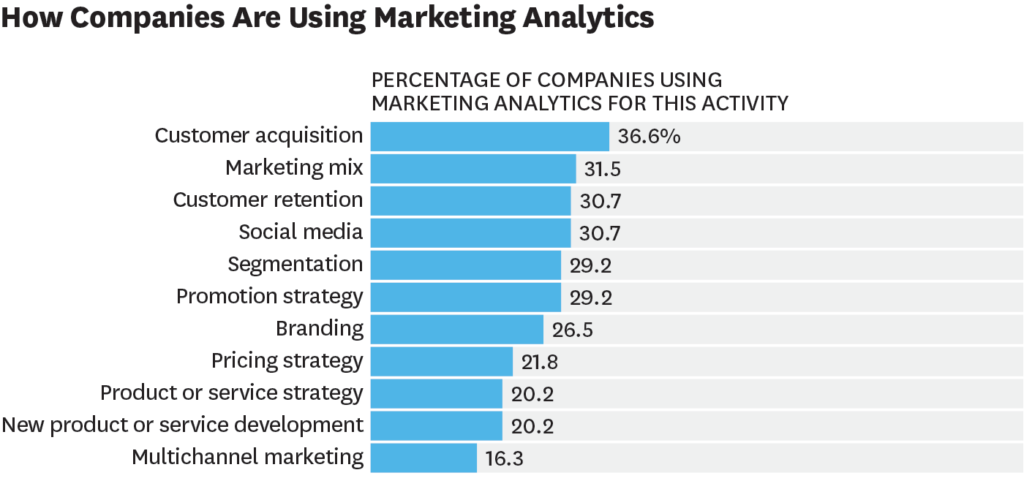
Image Source-CMOSURVEY.org
Challenges of Marketing Analytics
Marketing analytics holds the key to unlocking valuable insights and optimizing campaigns, but it’s not all sunshine and rainbows. The journey from data to meaningful action can be riddled with challenges that can trip up even the most seasoned marketers. Let’s dive into some of the common hurdles you might encounter:
Data Overload
Information Tsunami: Modern marketing generates data from multiple sources at a dizzying pace. Websites, social media platforms, email campaigns, and CRM systems all contribute to a data deluge, making it difficult to know where to start and what to prioritize.
Quality Control: Not all data is created equal. Inaccurate or incomplete data can lead to misleading insights and faulty decision-making. Ensuring data quality through proper collection, cleaning, and validation is crucial.
Technical Barriers
Tool Fatigue: The market is flooded with marketing analytics tools, each with its own strengths and weaknesses. Choosing the right tool for your needs and budget can be a daunting task.
Skill Gap: Effectively using analytics tools requires a certain level of technical expertise. Without proper training and understanding of data analysis techniques, interpreting results and drawing actionable insights can be challenging.
Interpretation and Action
Paralysis by Analysis: Getting bogged down in endless data exploration and statistical analysis can lead to inaction. It’s important to set clear objectives, identify key metrics, and focus on extracting actionable insights that can be translated into tangible marketing strategies.
Resistance to Change: Data-driven recommendations may challenge long-held assumptions or require changes to established marketing practices. Overcoming internal resistance and effectively communicating the value of data-driven decisions is crucial for successful implementation.
Beyond the Technical
Privacy Concerns: Navigating the ever-evolving landscape of data privacy regulations can be complex. Striking a balance between collecting valuable data and respecting user privacy is essential.
Organizational Sections: Data sections within different departments can hinder comprehensive analysis and limit the potential of marketing analytics. Fostering collaboration and breaking down data sections is key to maximizing its impact.
What are the Marketing Analytics Tools & Techniques?
Marketing analytics involves using data to understand how your marketing efforts are performing and identify areas for improvement. To achieve this, you need both tools to collect and analyze the data, and techniques to interpret and apply the insights gained. Here’s a breakdown:
Marketing Analytics Tools
These are software platforms and services that help you gather, organize, and analyze data from various marketing channels. Popular options include:
Web Analytics
Google Analytics: Free and widely used, it tracks website traffic, user behavior, and conversion rates.
Mixpanel: Focuses on user engagement and funnel analysis, ideal for complex product interactions.
Social Media Analytics
Hootsuite: Tracks brand mentions, engagement, and audience demographics across social platforms.
Sprout Social: Offers similar features to Hootsuite with advanced reporting and scheduling tools.
Email Marketing Analytics
Mailchimp: Provides insights on email opens, clicks, and unsubscribes to optimize email campaigns.
Constant Contact: Analyzes email performance and offers audience segmentation tools.
Marketing Automation Tools
HubSpot: All-in-one platform for marketing automation, CRM, and analytics.
Marketo: Powerful tool for lead generation, nurturing, and campaign management, with detailed analytics.
Marketing Analytics Techniques
Once you have the data, you need to know how to use it effectively. Here are some common techniques:
Conversion Funnel Analysis: Track users as they move through your marketing funnel and identify conversion bottlenecks.
Cohort Analysis: Group users based on shared characteristics and compare their behavior over time.
Segmentation Analysis: Divide your audience into smaller groups based on demographics, interests, or behavior, then tailor your marketing to each segment.
Marketing Mix Modeling: Understand the impact of different marketing channels on sales and ROI.
A/B Testing: Test different versions of your website, emails, or ads to see which one performs better.
How to Choose the Right Marketing Analytics Tools & Techniques?
The best tools and techniques for you will depend on your specific needs, budget, and technical expertise. Here are some tips for choosing:
Identify your goals: What do you want to achieve with marketing analytics?
Consider your resources: Do you have the time and expertise to manage complex tools?
Start small and scale up: Don’t try to do everything at once. Begin with a few basic tools and techniques and add more as needed.
Seek expert help: If you’re unsure where to start, consult with a marketing analytics professional.
Remember: Marketing analytics is an ongoing process. It’s not about just collecting data, but about using it to make informed decisions that improve your marketing performance.
How to Start Marketing Analytics Process of your Business?
Getting started with marketing analytics can be exciting, but also a bit daunting! Here’s a step-by-step guide to help you navigate the process:
1. Define your goals
What do you want to achieve with analytics? (e.g., increase website traffic, generate more leads, boost conversions).
What are your business objectives? Align your analytics goals with the overall business strategy.
2. Assess your capabilities
Technical skills: Do you or someone within your team have the ability to manage and analyze data?
Existing data infrastructure: Are there any marketing tools or platforms you’re already using that collect data?
Budget: Consider the costs of tools, training, or potential external support.
3. Gather data
Choose the right tools: Select tools that align with your goals and budget (e.g., Google Analytics for website traffic, social media analytics platforms for brand monitoring).
Connect data sources: Integrate different platforms and channels to provide a holistic view of your marketing performance.
Start small: Don’t overload yourself with too much data initially. Focus on key metrics relevant to your goals.
4. Analyze and interpret data
Learn basic data analysis techniques: Understand measures like averages, percentages, and correlations.
Utilize data visualization tools: Create charts and graphs to make data easier to understand and identify trends.
Focus on actionable insights: Don’t just look at numbers, ask “why” and “what can we do about it?”
5. Take action and optimize
Translate insights into actionable strategies: Based on your findings, adjust your marketing campaigns, channels, or messaging.
Test and iterate: Continuously measure the impact of your changes and refine your approach for better results.
Communicate insights: Share your findings with stakeholders to garner buy-in and support for improved marketing decision-making.
Bottom Line
In summary, it empowers businesses to make informed decisions, understand their customers better, optimize campaigns, and ultimately drive growth. The insights gained from analysisare invaluable in a world where data is king.
Whether you’re a small startup or a multinational corporation, harnessing the power of analytics can set you on a path to success. The honest & reliable web analytics expert has accurate knowledge to work with this process. They are well-versed with the tools and can provide you accurate insights about your business.
So, if you haven’t already, it’s time to embrace data-driven marketing and unlock the full potential of your business. Your competition is already doing it, and the insights you gain can make all the difference in achieving your marketing goals and securing a bright future for your business.
What is strategic outsourcing? Well, it’s a business model that allows companies to selectively delegate specific tasks or processes to external service providers. The advantages of outsourcing are particularly significant for startups that may lack the resources to hire full-time experts for every function. By leveraging the specialized expertise of customer service outsourcing companies, content moderation outsourcing agencies, or call center outsourcing firms, startups can embrace strategic outsourcing to optimize their operations. This approach enables startups to channel their resources on core business functions, ultimately driving innovation and growth. In summary, strategic outsourcing is a crucial element in the startup business model. It allows startups to access expertise and skills critical for their success, foster efficiency, and keep costs low.
Advantages of Strategic Outsourcing for Startups
Outsourcing is a strategic move that can benefit startups in several ways. Firstly, it gives them access to specialized expertise that they may not be able to afford in-house. Whether it’s customer service outsourcing or content moderation outsourcing, startups can tap into a pool of highly skilled professionals as and when needed. This level of expertise can significantly boost growth and even fuel innovation within the startup. Secondly, outsourcing non-core tasks allows startups to focus on their core business functions. For instance, by outsourcing call center operations to a call center outsourcing company, startups can concentrate on areas like product development or sales. This sharp focus on core competencies can enhance productivity, improve product or service quality, and ultimately drive business growth. Lastly, cost optimization is another significant benefit of strategic outsourcing. Startups can significantly reduce overhead costs by outsourcing tasks that would be more expensive to execute in-house, such as back office outsourcing services. This strategy helps startups maintain financial sustainability while freeing up funds that can be reinvested into growth-driving activities. So, outsourcing not only supports startups to stay lean and agile, but it also offers access to high-quality expertise, enabling growth and innovation. What’s not to love about that?
Role of Strategic Outsourcing in Startup Business Model
When it comes to startups, strategic outsourcing can play a crucial role in accessing expertise and skills that may be too costly or challenging to develop in-house. By outsourcing non-core tasks, startups can concentrate their resources on core business functions that directly contribute to their growth and success. This allows startups to stay lean and agile, freeing up their resources to focus on their primary business functions. One of the most significant benefits of outsourcing is the access to specialized expertise it provides. Startups often lack the resources to hire full-time experts for every function, but through outsourcing, they can tap into a pool of highly skilled professionals as and when needed. This level of expertise can fuel growth and foster innovation within the startup. Strategic outsourcing empowers startups to customize their outsourcing strategies to align with their business goals, ultimately driving growth, enhancing efficiency, and increasing overall competitiveness in the market. By entrusting these specialized service providers with essential functions, startups can create space for innovation that becomes a driving force that propels them toward the path of success. So, if you are a startup looking for ways to leverage innovation and growth while keeping your costs low, outsourcing may just be the solution you need.
Identifying Functions to Outsource
When it comes to identifying functions to outsource, startups need to consider various factors. Some of these include the startup’s core competencies, cost-effectiveness, and potential impact on business operations. Startups need to ensure that the outsourcing decisions align with their overall business goals. This means that they need to evaluate the functions that need outsourcing and determine if they fit in with their broader business objectives. For example, if customer satisfaction is a priority, they might choose to outsource customer interactions to a specialized call center outsourcing company. When identifying functions to outsource, startups need to ensure that they do not overlook any critical business functions, as this may lead to challenges down the line. With clear criteria for selecting outsourcing functions, startups can leverage outsourcing to their advantage and drive innovation and growth.
Building Effective Outsourcing Relationships
Building Effective Outsourcing Relationships Outsourcing is not just about task delegation – it involves building a mutually beneficial relationship that contributes to the success of the startup. To achieve this, startups need to establish clear expectations from the outset and maintain open communication throughout the partnership. Effective communication ensures the smooth running of outsourced functions and helps to identify and address problems quickly. Furthermore, fostering a partnership for long-term success is crucial. The outsourcing agency should not just be seen as a vendor but as an extension of the startup’s team. A successful outsourcing relationship entails setting out roles and responsibilities, developing trust, and a willingness to work together towards shared objectives. Startups should regularly review the outsourcing agency’s performance and provide useful feedback to ensure constant improvement. With the right outsourcing relationship, startups can benefit from expertise, streamline operations and grow exponentially. However, outsourcing is not without its challenges, and startups should take steps to mitigate risks such as poor communication, higher-than-expected costs, and quality control issues. At the core of successful outsourcing is establishing communication and a partnership that drives innovation and growth and contributes to the long-term success of the startup.
Potential Pitfalls and Challenges of Outsourcing – and How to Avoid Them
Outsourcing is not a cure-all solution for startups. Like any business process, it comes with its pitfalls and challenges that, if ignored, will negate the benefits of outsourcing. Common outsourcing pitfalls for startups include underestimating the cost of outsourcing, poor communication, and issues with quality control. If not addressed, these challenges can heavily impact a startup’s potential for growth and success. However, startups can mitigate outsourcing risks by implementing several strategies. Clear communication and clarity of expectations are crucial to ensuring that the outsourcing agency understands what is required of them. Conducting due diligence by thoroughly vetting potential partners is also essential. This process ensures that the outsourcing agencies align with the startup’s culture, goals, and business needs. Periodic reviews and feedback are also vital to ensure the outsourcing relationship remains effective. Remember that strategic outsourcing is not a one-size-fits-all solution for startups. Each company has its unique needs and challenges that must be considered when making outsourcing decisions. With careful planning and implementation, startups can leverage the power of outsourcing to drive innovation and growth while avoiding potential pitfalls.
Outsourcing for Startups: Bottom Line
Outsourcing is a strategic move that startups can leverage to drive growth, efficiency, and innovation. By choosing to outsource non-core functions, startups can free up their resources and focus on core competencies, ultimately driving productivity and quality. Outsourcing also provides access to specialized expertise and skills that may be too costly or challenging to develop in-house. The benefits of strategic outsourcing for startups are numerous, including cost optimization, brand image enhancement, improved customer satisfaction, and the creation of space for innovation. When done right, outsourcing can become a powerful tool for driving innovation and growth, propelling startups toward long-term success.
We use cookies on our website to give you the most relevant experience by remembering your preferences and repeat visits. By clicking “Accept”, you consent to the use of ALL the cookies.
This website uses cookies to improve your experience while you navigate through the website. Out of these, the cookies that are categorized as necessary are stored on your browser as they are essential for the working of basic functionalities of the website. We also use third-party cookies that help us analyze and understand how you use this website. These cookies will be stored in your browser only with your consent. You also have the option to opt-out of these cookies. But opting out of some of these cookies may affect your browsing experience.
Necessary cookies are absolutely essential for the website to function properly. These cookies ensure basic functionalities and security features of the website, anonymously.
Cookie
Duration
Description
cookielawinfo-checbox-analytics
11 months
This cookie is set by GDPR Cookie Consent plugin. The cookie is used to store the user consent for the cookies in the category "Analytics".
cookielawinfo-checbox-functional
11 months
The cookie is set by GDPR cookie consent to record the user consent for the cookies in the category "Functional".
cookielawinfo-checbox-others
11 months
This cookie is set by GDPR Cookie Consent plugin. The cookie is used to store the user consent for the cookies in the category "Other.
cookielawinfo-checkbox-necessary
11 months
This cookie is set by GDPR Cookie Consent plugin. The cookies is used to store the user consent for the cookies in the category "Necessary".
cookielawinfo-checkbox-performance
11 months
This cookie is set by GDPR Cookie Consent plugin. The cookie is used to store the user consent for the cookies in the category "Performance".
viewed_cookie_policy
11 months
The cookie is set by the GDPR Cookie Consent plugin and is used to store whether or not user has consented to the use of cookies. It does not store any personal data.
Functional cookies help to perform certain functionalities like sharing the content of the website on social media platforms, collect feedbacks, and other third-party features.
Performance cookies are used to understand and analyze the key performance indexes of the website which helps in delivering a better user experience for the visitors.
Analytical cookies are used to understand how visitors interact with the website. These cookies help provide information on metrics the number of visitors, bounce rate, traffic source, etc.
Advertisement cookies are used to provide visitors with relevant ads and marketing campaigns. These cookies track visitors across websites and collect information to provide customized ads.