Here is what is happening to your organic traffic right now, whether you know it or not.
Someone searches for a problem your business solves. An AI — ChatGPT, Perplexity, Google’s AI Overview — pulls together an answer. It names a few companies as sources. It cites a few URLs. The user reads the summary, gets what they came for, and leaves.
Your website was never visited. Your #1 ranking never helped you. And your competitor, who optimized for AI search six months ago, just got a citation that will compound every single day.
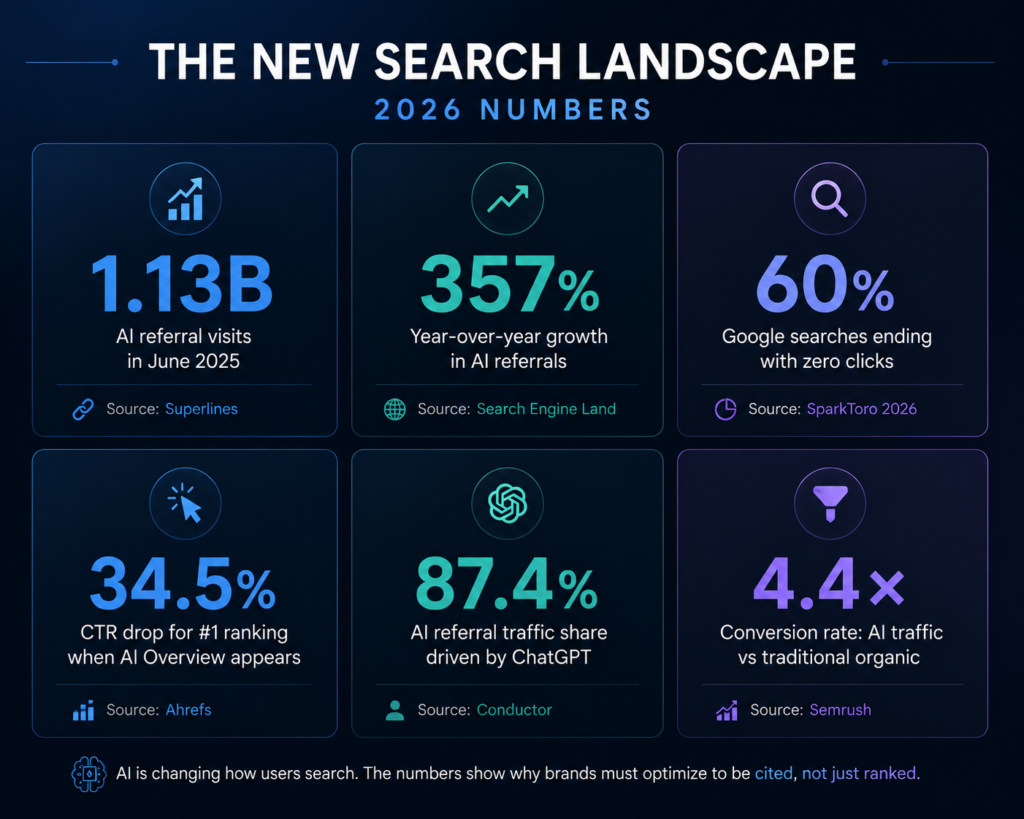
This is not a prediction about the future. AI platforms generated over 1.13 billion referral visits in June 2025 alone — a 357% increase year-over-year. And 60% of Google searches now end without a single click to any website. The traffic that used to flow through to your site is being absorbed by AI-generated answers.
The question is not whether to optimize for AI search. It is whether you do it before your competitors do.
This guide gives you the exact playbook.
Why Traditional SEO Is No Longer Enough
Here is what is happening to your organic traffic right now, whether you know it or not.
Someone searches for a problem your business solves. An AI tool, whether ChatGPT, Perplexity, or Google’s AI Overview, pulls together an answer. It names a few companies as sources. It cites a few URLs. The user reads the summary, gets what they came for, and leaves. Your website never saw them. Your number-one ranking never helped you. Meanwhile, your competitor, who optimized for AI search six months ago, collected a citation that compounds every single day.
This is not a prediction about the future. AI platforms generated over 1.13 billion referral visits in June 2025 alone, a 357% increase year-over-year. Furthermore, 60% of Google searches now end without a single click to any website. The traffic that used to flow to your site now gets absorbed directly into AI-generated answers.
The question, therefore, is not whether to optimize for AI search. It is whether you do it before your competitors do.
The CTR Numbers That Define 2026
The data makes a clear case for action. Position-one CTR drops by 34.5% the moment a Google AI Overview appears above it. More aggressive studies put that figure at 58%. Either way, the ranking you spent months earning now delivers materially fewer clicks than it did a year ago.
The structural shift goes even deeper than CTR. The overlap between top-10 Google rankings and AI Overview citations has collapsed from 75% in mid-2025 to between 17% and 38% by early 2026. In practice, that means roughly 62 to 83% of the sources AI answers cite are not the pages ranking at the top of Google. They come from a different pool, chosen by a different logic.
What GEO Changes About Your Strategy
The pages earning AI citations are not necessarily the ones with the most backlinks. Instead, they are the ones written clearly enough for an AI to extract a trustworthy answer, attributed to a credible source, and structured in a way that makes the AI’s job easy. That is a different optimization problem, and it has a name: Generative Engine Optimization (GEO).
GEO is the practice of structuring your content so AI platforms, including ChatGPT, Perplexity, Google AI Overviews, Claude, and Gemini, cite, reference, or recommend your content when users ask questions in your niche. It does not replace traditional SEO. Rather, it runs parallel to it, and in 2026, it is becoming the higher-leverage channel.
Early adopters of AI visibility optimization report up to 527% year-over-year growth in AI-driven search traffic. Moreover, when they earn citations, the conversion quality is exceptional. AI-referred traffic converts at 4.4 times the rate of traditional organic search, because visitors arrive already informed and further along in their buying decision.
How Each AI Platform Actually Selects Sources
ChatGPT, Perplexity, and Google AI Overviews each select citation sources differently. Understanding the selection logic of each platform, therefore, is the foundation of any AI-powered SEO strategy. They share common preferences, including structured content, authoritative sources, and direct answers. However, they do not cite the same pages.
Only 11% of domains earn citations from both ChatGPT and Perplexity. That finding is critical. It means you cannot optimize for one and assume you will rank on the other. Consequently, each platform requires its own approach.
ChatGPT Search
ChatGPT Search prioritizes domain reputation and content readability. Interestingly, it primarily cites pages ranking at position 21 or lower in Google in about 90% of cases, meaning it actively favors different sources than traditional Google results. It weighs brand mentions across the web, readability scores, and whether your content directly answers the question a user asks. ChatGPT now processes 2.5 billion prompts per day and has 900 million weekly active users as of February 2026, making it the single largest AI search surface for most businesses.
Perplexity
Perplexity operates as a citation-first search engine. It attributes every claim to a specific source, which makes it both more transparent and more demanding about source quality. It generates an estimated 780 million monthly queries and serves as the default research tool for professionals, developers, and analysts. Specifically, Perplexity favors pages with clear structure, factual accuracy, and accessibility to its crawler. Earned media, including third-party mentions, authoritative publications, and domain credibility, carries the most weight on this platform.
Google AI Overviews
AI Overviews now appear inover 25% of all Google searches, serving 2 billion monthly users across 200+ countries. They pull heavily from pages that already rank organically. In fact, 76.1% of URLs cited in AI Overviews also rank in Google’s top 10,</a> making this the one AI surface where traditional SEO directly feeds AI visibility. Schema markup, E-E-A-T signals, and structured content are the levers that matter most here.
The VASE Method: 4 Pillars of AI Search Visibility
The VASE Method is a four-pillar framework for building AI search visibility across ChatGPT, Perplexity, and Google AI Overviews simultaneously. Each pillar targets a different factor that AI platforms use to select and cite sources.
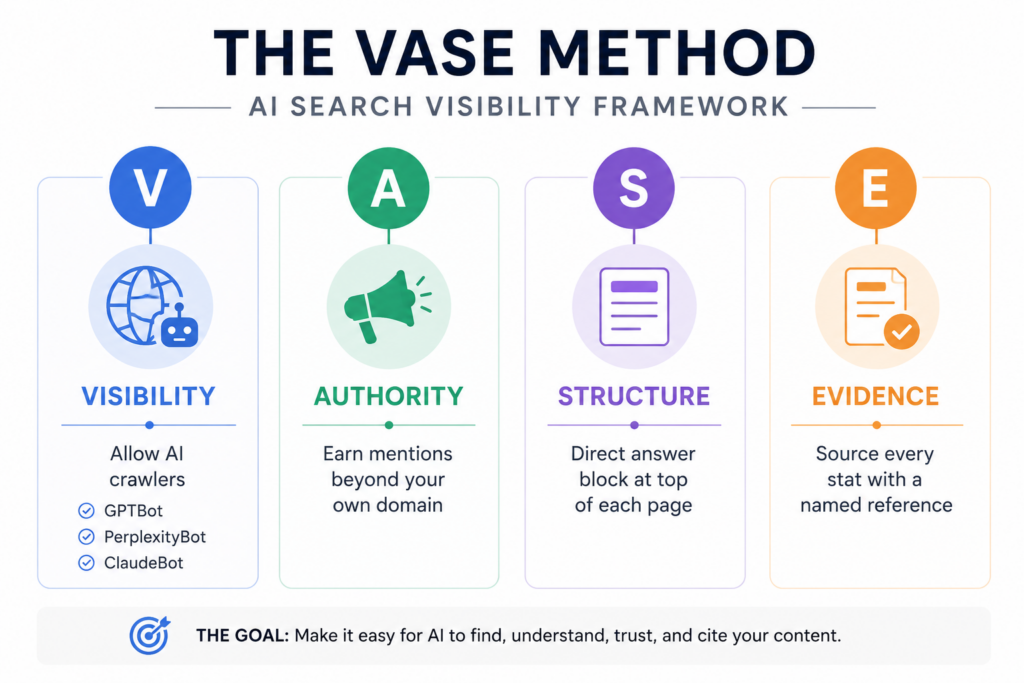
V — Visibility → Is your content accessible to AI crawlers?
A — Authority → Does the broader web treat you as a trusted source?
S — Structure → Can an AI extract a direct, clean answer from your page?
E — Evidence → Does your content back claims with sources and data?
You do not need to perfect all four at once. Most businesses already have one or two pillars in reasonable shape. The gap, however, is usually in Structure and Evidence, the two pillars that most directly influence whether an AI can extract and cite your content.
V — Visibility (Technical Access)
Your content is worthless to an AI if its crawler cannot read your pages. Visibility means allowing GPTBot (ChatGPT), PerplexityBot, Claudebot, and GoogleBot in your robots.txt, all four, explicitly. It also means avoiding JavaScript-only rendering for key content, maintaining a clean sitemap.xml, fast load times, and no crawl blocks on your most important pages.
A — Authority (Third-Party Signals)
AI platforms do not just read your website. They read the whole web. The brands that get cited most frequently by ChatGPT and Perplexity are brands with a strong footprint beyond their own domain — mentions in industry publications, Reddit threads, Wikipedia references, podcasts, and Q&A platforms. 90% of AI citations driving brand visibility originate from earned and owned media, not paid placements. You cannot buy your way into AI citations. You earn them.
S — Structure (Content Format)
This is the highest-leverage pillar for most businesses. Pages with well-organised headings are 2.8× more likely to earn citations in AI search results. Direct answer blocks at the start of each section — a 40–60 word answer to the exact question the heading asks — are the single most impactful formatting change you can make today. Tables, bullet lists, numbered steps, and FAQ blocks all signal to AI systems that your content is structured for extraction.
E — Evidence (Sourced Claims)
AI systems are trained to distrust unsourced claims and favour content that cites data, studies, and named sources. Every statistical claim in your content should have a source. Every significant assertion should be backed by evidence. Listicle and comparative content with cited data dominates AI citations, representing 25.37% of all AI citations across 2.6 billion analysed citations.
Optimizing Specifically for ChatGPT
To appear in ChatGPT Search results, prioritise domain reputation, content readability, brand mentions across the web, and explicit access for GPTBot. ChatGPT cites pages that directly answer the query — it does not need you to rank highly on Google first.
Here is what moves the needle specifically for ChatGPT:
Allow GPTBot in your robots.txt
This is the first thing to check. If your robots.txt blocks OpenAI’s crawler, ChatGPT cannot access your pages. Add this if it is missing:
User-agent: GPTBot
Allow: /
Write with a direct answer in the first paragraph
ChatGPT Search is looking for pages that answer the user’s question immediately. Before any background, context, or explanation — put a 40–60 word direct answer to the question the page is targeting. This is what gets extracted into the AI answer.
Build brand mentions off your domain
Get mentioned in Reddit, Quora, industry forums, trade publications, and directories in your space. The top cited domains in ChatGPT include Reddit, Wikipedia, Amazon, Forbes, and Business Insider. Being mentioned in those environments, or in publications at a similar authority level, correlates with ChatGPT citation rates.
Use FAQ schema on every key page
ChatGPT surfaces FAQ-structured content readily. Add FAQ schema to your service pages, blog posts, and landing pages. Every FAQ answer should be a direct, self-contained response to the question — not a teaser that requires clicking through.
Optimizing Specifically for Perplexity
Perplexity prioritises citation quality, factual accuracy, and direct source attribution. To appear in Perplexity results, make your content crawlable, source every claim, and earn third-party mentions from credible domains in your industry.
Perplexity’s citation logic is the most transparent of the major AI search platforms — it shows users exactly where each answer came from. That transparency means its selection criteria are also more observable.
Allow PerplexityBot explicitly
User-agent: PerplexityBot
Allow: /
Source every factual claim Perplexity values content that mirrors the citation standards of journalism or academic writing. When you make a data claim, link to the primary source. When you reference a study, name it. When you quote a statistic, attribute it. Unsourced claims are a credibility signal against you.
Target comparison and listicle formats Comparison and listicle formats represent 25.37% of all AI citations across major platforms including Perplexity. “X vs Y” posts, “Best tools for [task]” roundups, and “How to [do X] in [number] steps” guides are the formats Perplexity pulls from most.
Earn mentions on community platforms Perplexity frequently surfaces content from Reddit, Quora, and Wikipedia. Building a brand presence on these platforms — answering questions in your niche, contributing useful responses, maintaining a Wikipedia entry if your company qualifies — directly feeds Perplexity citation likelihood.
Optimizing for Google AI Overviews
Google AI Overviews pull primarily from pages that already rank in the top 10 organically, but traditional rankings alone are not enough. Pages cited in AI Overviews earn 35% more organic clicks and 91% more paid clicks than non-cited pages — making citation the new position zero.
Being cited in a Google AI Overview is more valuable than ranking #1 without a citation. Brands cited in AI Overviews earn 35% more organic clicks and 91% more paid clicks than non-cited brands. And 70% of pages cited in AI Overviews change over a 2–3 month period, meaning this is not a static list — it is actively refreshed, and well-optimised new content can earn citations.
Apply Article + FAQPage schema on every blog post Schema-rich pages are strongly favoured by Google AI Overviews. Apply Article schema to all editorial content. Add FAQPage schema to any page that answers questions. These are the two schemas with the most direct impact on AI Overview citation rates.
Strengthen your E-E-A-T signals Author bios, publication dates, “last updated” markers, and clear expertise signals all feed Google’s E-E-A-T (Experience, Expertise, Authoritativeness, Trustworthiness) scoring. Google uses E-E-A-T heavily when deciding which sources to cite in AI-generated answers.
Target featured snippet formats The content formats that historically won featured snippets — direct definitions, step-by-step numbered lists, concise tables — are the same formats Google AI Overviews pull from. If you are already optimising for featured snippets, you are most of the way to AI Overview optimisation.
Update content regularly Stale content loses AI Overview citations. The 70% citation churn rate over 2–3 months means that regularly updated, freshly sourced content has a material advantage over static pages.
Technical Setup: Making Your Site AI-Crawlable
AI search visibility starts with technical access. If AI crawlers cannot read your pages, no amount of content quality will get you cited. Here is the complete technical checklist.
robots.txt allow all major AI crawlers:
User-agent: GPTBot
Allow: /User-agent: PerplexityBot
Allow: /User-agent: ClaudeBot
Allow: /User-agent: Bingbot
Allow: /User-agent: Googlebot
Allow: /
Schema markup — minimum viable setup:
ArticleorBlogPostingon all editorial contentFAQPageon any page with Q&A contentOrganizationon your homepageBreadcrumbListfor site navigation structure
Content rendering:
- Ensure critical page content is in HTML, not JavaScript-rendered
- AI crawlers vary in JavaScript execution capability — do not put key copy or headings inside dynamic JS components
Page speed:
- Target Core Web Vitals pass — slow pages are deprioritised by both Google and AI crawlers
- Use a CDN for global content delivery
llms.txt (optional but low-effort): A plain-text file at yoursite.com/llms.txt that describes your site’s purpose and primary content categories. No major AI provider has confirmed it as a ranking signal, but it takes 30 minutes to set up and is reasonable insurance.
How to Track Your AI Search Visibility
You cannot improve what you cannot measure. AI search visibility requires different tracking methods than traditional SEO — Google Search Console does not show you ChatGPT citations.
Manual audit (free, start here): Query your 10–20 most important commercial questions across ChatGPT, Perplexity, Gemini, and Google AI Mode. Note: Is your brand named? Is your domain cited? What competitors are cited instead? Do this monthly and document changes. This costs nothing and reveals more than any paid tool at the start.
Search Console for AI Overviews: Google added dedicated AI search tracking to Search Console in mid-2025. Go to Performance → Search Results → Filter → Search Appearance → AI Mode. This shows you which queries surfaced your content inside Google’s AI-generated responses.
Paid tools for scale:
- Semrush AI Toolkit — tracks visibility across ChatGPT, Google AI Mode, and Perplexity
- Ahrefs Brand Radar — monitors brand mentions in AI Overviews and generative results
- Otterly.ai — monitors brand mentions across multiple AI platforms with citation alerts
- SE Ranking — tracks citations in ChatGPT and Perplexity responses by target keyword
GA4 — tag your AI referral traffic: In GA4, create a custom channel grouping for AI referral traffic. Tag sessions from chat.openai.com, perplexity.ai, gemini.google.com, and bing.com/chat as a unified AI channel. This lets you measure AI-referred sessions, conversion rate, and revenue contribution separately from traditional organic.
The 30-Day AI SEO Action Plan
You do not need six months to see results from this. Here is a sequenced 30-day plan that prioritises highest-impact actions first.
Week 1 — Audit and Access
- Run a manual citation audit: query your top 20 commercial questions across ChatGPT, Perplexity, Gemini, and Google AI Mode. Document who is cited. Note where you appear and where competitors appear instead.
- Check and update
robots.txtto allow all four AI crawlers explicitly. - Set up GA4 AI referral channel grouping.
- Set up Search Console AI Mode filter.
Week 2 — Structure Your Top 10 Pages
- Identify your 10 highest-traffic or highest-value pages.
- Add a 40–60 word direct answer block at the top of each page — before any introduction or context.
- Add or update H2 headings to be question-formatted where relevant.
- Apply
ArticleandFAQPageschema to blog posts and informational pages.
Week 3 — Authority Building
- Identify 5 relevant Reddit communities or Quora topics in your niche. Answer 2–3 questions per platform per week with substantive responses that include your brand name and URL where appropriate.
- Reach out to 3 industry publications for guest contribution or data-sharing opportunities.
- Audit your Wikipedia presence — does your company or any key topics you own have a Wikipedia page? If yes, ensure accuracy. If your company qualifies, consider creating one.
Week 4 — Content and Measurement
- Publish one comparison piece (“X vs Y: Which is better for [use case]?”) — this format outperforms across all AI citation platforms.
- Publish one data-led piece with original statistics or compiled research — cited data is one of the strongest GEO signals.
- Rerun your manual citation audit from Week 1 and compare. Note any changes.
- Review GA4 AI referral traffic. Set a monthly baseline.
Ready to Show Up Where Your Buyers Are Searching?
Your competitors are already building AI citation footprints. The businesses that start now hold a compounding advantage that becomes very difficult to close after 12 months.
If you want a full AI visibility audit for your site, a custom GEO strategy, or hands-on training for your content team, let’s talk. We will show you exactly where you appear and where you do not across ChatGPT, Perplexity, and Google AI Overviews, and what it takes to change that.
frequently Asked Questions
AI-powered SEO — also called GEO (Generative Engine Optimization) or AEO (Answer Engine Optimization) — is the practice of optimising content to appear in AI-generated answers from platforms like ChatGPT, Perplexity, Google AI Overviews, and Gemini. Traditional SEO targets ranked link positions in a search results page. AI-powered SEO targets citations inside the AI-generated answer that appears before those links. The two approaches are complementary, but they require different content structures, different technical signals, and different authority-building strategies.
Yes, but it matters differently. Ranking highly on Google still feeds your probability of being cited in Google AI Overviews — 76.1% of AI Overview citations come from pages in the top 10 organically. But ranking alone is no longer sufficient. The pages being cited in AI answers are structured, sourced, and formatted for extraction — which is a separate optimisation layer that many high-ranking pages have not yet applied. The goal in 2026 is to rank well AND be optimised for AI citation.
Five things drive ChatGPT citation rates most consistently: (1) allowing GPTBot access in your robots.txt, (2) writing a direct 40–60 word answer at the top of each page, (3) earning brand mentions across Reddit, Quora, and industry publications, (4) using FAQPage schema on key pages, and (5) maintaining consistent brand signals across the web. ChatGPT is less dependent on Google rankings than AI Overviews — it cites pages that are clearly written, credibly sourced, and accessible to its crawler.
Yes. Only 11% of domains are cited by both ChatGPT and Perplexity — meaning they are selecting from largely different source pools. Perplexity prioritises citation quality, sourced claims, and comparison/listicle formats. It is particularly important for B2B companies targeting researchers, developers, and analysts, because those audiences disproportionately use Perplexity as their search tool. Optimising for both requires additional effort but addresses meaningfully different audiences.
Significantly, and the effect is structural rather than temporary. Organic CTR drops 34.5–61% for queries where a Google AI Overview appears. 60% of Google searches end without a click to any website. Even queries without an AI Overview have seen organic CTR decline 41% year-over-year, as users increasingly go directly to ChatGPT or Perplexity and bypass Google altogether. Gartner projects 25% of organic search traffic will shift to AI chatbots and voice assistants by 2028. The businesses adapting now are building the citation footprints that will compound over that period.
Start with the free options: manual audits across ChatGPT, Perplexity, and Gemini, plus Google Search Console’s AI Mode filter. For scale, Semrush AI Toolkit, Ahrefs Brand Radar, Otterly.ai, and SE Ranking all offer AI citation monitoring. Set up a GA4 custom channel grouping for AI referral traffic to measure conversion rate and revenue contribution separately from traditional organic. For most businesses, the manual audit plus Search Console is sufficient for the first 60–90 days.
Both — but the balance is shifting. GEO does not replace traditional SEO; it extends it. Most of the technical foundations are shared (crawlability, schema, site speed, E-E-A-T). What GEO adds is content structure optimised for AI extraction, authority-building beyond your domain, and platform-specific optimisation for ChatGPT, Perplexity, and AI Overviews. The businesses doing best in AI search are not abandoning traditional SEO — they are layering GEO on top of a solid SEO foundation, not treating them as alternatives.