There’s a line most companies haven’t crossed yet, and it’s not about having AI.
It’s about what the AI actually does.
For the past few years, “AI adoption” meant giving employees a chatbot, a writing assistant, or a dashboard with predictive analytics. The AI answered questions. Humans still made the decisions, ran the workflows, and did the follow-through.
That’s changing fast, and 2026 is the year where the gap between companies that understand the shift and companies that don’t will start to show up in actual business results.
The shift is called agentic AI. Here’s what it actually means, why it matters to your business right now, and what to do about it.
What “Agentic AI” Actually Means (No Jargon)
An AI agent doesn’t just respond. It acts.
Give a standard AI a task, and it gives you an output. Give an agentic AI system a goal — it figures out the steps, uses the tools it has access to (databases, APIs, browsers, internal systems), executes across those steps, checks its own work, and adjusts when something goes wrong.
Think of the difference between an assistant who answers your question and an assistant who runs the whole project.
That’s what’s happening right now inside enterprise software. AI is moving from a layer you query to a layer that operates — handling customer service tickets end-to-end, writing and testing code, managing procurement approvals, detecting and responding to security threats — without waiting for a human to press “go” on each step.
The Numbers Business Leaders Should Know
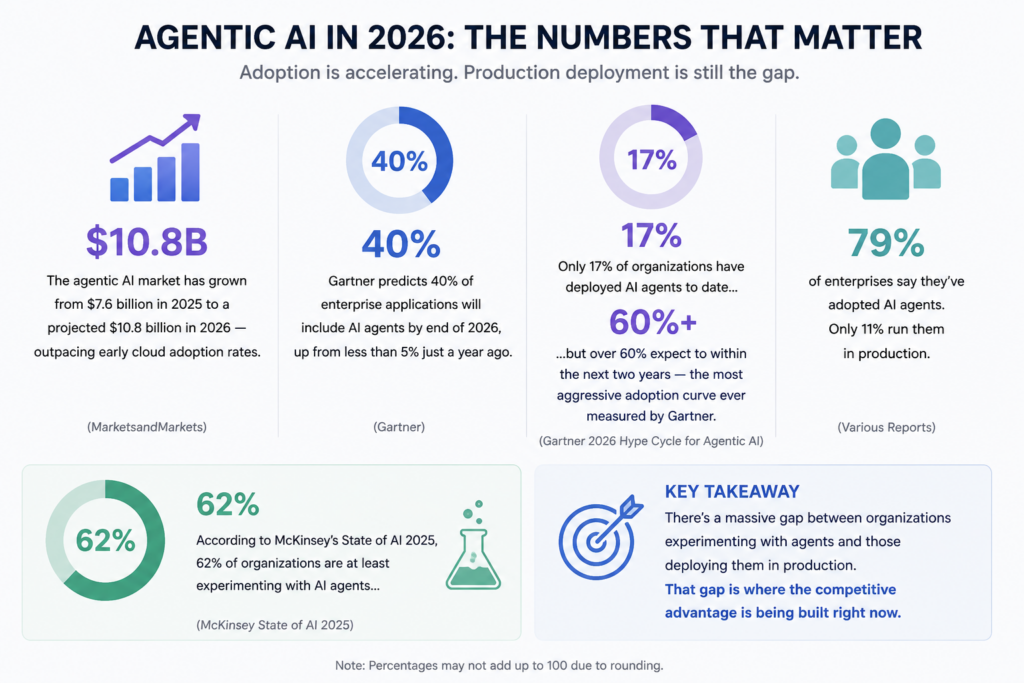
This isn’t speculation. Here’s where the market actually stands in 2026:
- The agentic AI market has grown from $7.6 billion in 2025 to a projected $10.8 billion in 2026 — outpacing early cloud adoption rates.
- Gartner predicts 40% of enterprise applications will include AI agents by end of 2026, up from less than 5% just a year ago.
- Only 17% of organizations have deployed AI agents to date, but over 60% expect to within the next two years — the most aggressive adoption curve of any emerging technology Gartner has measured.
- 79% of enterprises say they’ve adopted AI agents. Only 11% run them in production.
- According to McKinsey’s State of AI 2025, 62% of organizations are at least experimenting with AI agents
That last number is the one to pay attention to. There’s a massive gap between organizations experimenting with agents and organizations actually deploying them in ways that move business metrics. That gap is where the competitive advantage is being built right now.
Why 2026 Is Different From Every Prior Year of “AI Hype”
Here’s what’s actually changed.
For most of 2023 and 2024, agentic AI was a compelling demo. The models were capable, but the infrastructure around them — the orchestration frameworks, governance tools, security layers, integration standards — wasn’t production-ready. Most pilots stalled.
That’s no longer the case.
The architecture has matured. Enterprises now have the orchestration frameworks, governance models, and observability platforms required to deploy AI agents in real workflows without losing control or accountability. The challenge in 2026 isn’t “can we build this?” — it’s “are we executing well enough?”
Standards have arrived. Emerging interoperability protocols are defining how agents connect to tools and how agents communicate with each other. The business implication: more plug-and-play integration, less custom engineering work, and a real path toward multi-vendor agent ecosystems.
The ROI is measurable now. PwC estimates that AI agents can take on roughly half of the tasks in many business functions. That’s not a benchmark score — that’s an operational reality that forward-leaning organizations are already building around.
Where Agentic AI Is Actually Working Right Now
The use cases that have moved past pilot stage and into production:
Software Engineering Agent-assisted development is no longer about autocomplete. Development teams are deploying agents that write code, run tests, identify bugs, propose fixes, and open pull requests — reducing review cycles and shipping time in ways that compound over quarters, not years.
Customer Operations The most mature enterprise deployment area. AI agents handle intake, routing, research, and resolution for a significant percentage of support volume — not just the simple tickets, but complex multi-step requests that previously required a human to dig through four systems.
Financial Monitoring and Controls Agents that watch financial data in real time, flag anomalies, execute pre-approved responses (blocking a transaction, escalating a variance), and log the full decision trail for audit. The finance teams at organizations running these systems have shifted from catching problems after the fact to preventing them in the first place.
Security and Threat Response Autonomous agents that detect anomalous behavior, cross-reference threat intelligence, and initiate response protocols — all before a human analyst opens their laptop. Security teams are still in the loop, but their role has shifted from first responder to decision-maker on escalations.
The Honest Problem: Why Most Deployments Stall
Gartner has flagged that over 40% of agentic AI projects are at risk of cancellation by 2027. The reasons are consistent: escalating costs, unclear business value, and inadequate governance.
Here’s what’s actually happening in organizations that are stuck:
They started with the technology, not the workflow. The question “what can our AI agent do?” is less useful than “what specific business process costs us the most in time, errors, or headcount — and can an agent own part of it?” The organizations running agents in production started with the second question.
They underestimated the 80/20 problem. PwC’s analysis is direct: technology delivers about 20% of the value in an agentic initiative. The other 80% comes from redesigning work around it. Organizations that deployed agents into unchanged processes got unchanged results, just faster.
They skipped governance. Agents that can act can also act wrong — at scale, quickly, with consequences. The organizations that have successfully expanded agent autonomy over time are the ones that built governance into the design from day one: clear boundaries, audit trails, escalation paths, human checkpoints at high-stakes decision points.
What “Governance” Actually Means for Agents (Practically)
This is the part most leadership discussions skip, because it sounds like a compliance problem. It isn’t.
Agent governance is about knowing what your agents are doing, setting the right boundaries, and building the kind of accountability structure that lets you expand agent autonomy over time with confidence rather than restrict it after something goes wrong.
In practice, that means:
Permissions and scope boundaries — what systems can the agent access? What actions can it take independently versus what requires approval?
Audit trails — every agent action logged, with enough context to understand why it happened and who (or what) authorized it.
Escalation design — clear criteria for when an agent hands off to a human, and a handoff that doesn’t drop context.
Governance agents — a growing practice in 2026: deploying monitoring agents whose job is to watch other AI systems for policy violations and anomalous behavior.
The organizations that get this right don’t just reduce risk. They build the institutional confidence to deploy agents in higher-value scenarios — a compounding advantage.
The Strategic Decision You’re Actually Making
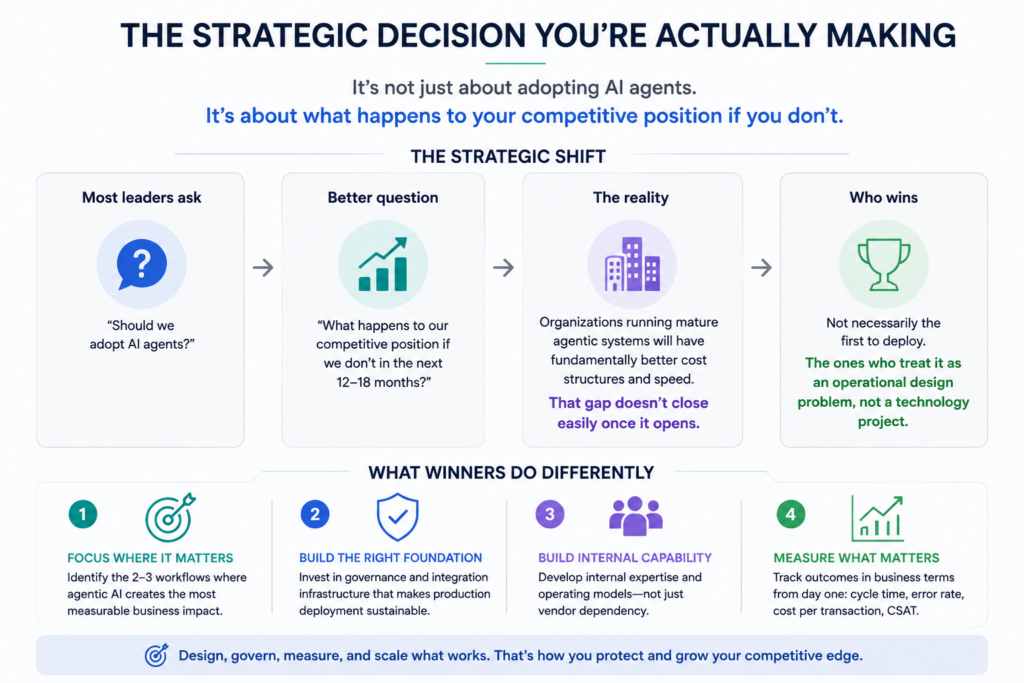
Most business leaders frame the agentic AI question as: should we adopt AI agents?
The better frame is: what happens to our competitive position if our peers deploy agentic systems in the next 12-18 months and we don’t?
In areas like customer operations, software development, and financial controls, organizations running mature agentic systems are operating with fundamentally different cost structures and speed profiles than those that aren’t. That gap doesn’t close easily once it opens.
The organizations that will come out ahead aren’t necessarily the first to deploy agents. They’re the ones that treat this as an operational design problem, not a technology project. That means:
- Identifying the two or three workflows where agentic AI creates the most measurable business impact
- Investing in the governance and integration infrastructure that makes production deployment sustainable
- Building internal capability, not just vendor dependency
- Measuring outcomes in business terms (cycle time, error rate, cost per transaction) from day one
The Bottom Line
Agentic AI is past the point of being a “watch this space” topic.
The market is moving. The infrastructure is ready. The early deployments have produced the playbooks. The organizations sitting in pilot mode through the rest of 2026 aren’t being cautious — they’re ceding ground.
The question isn’t whether AI agents will be part of how enterprise businesses operate. They already are. The question is whether your organization is building the capability to deploy them deliberately, govern them responsibly, and scale what works — or whether you’ll be catching up to organizations that started 18 months earlier.
That’s the decision in front of you right now. Curious where AI agents could fit in your business? Let’s find out together →
Frequently Asked Questions
Q1: What is agentic AI and how is it different from regular AI?
Regular AI responds to a prompt — it answers a question, generates text, or completes a task when you ask. Agentic AI acts autonomously toward a goal. It plans the steps, uses tools (like APIs, databases, or browsers), executes across multiple actions, checks its own output, and adjusts when something goes wrong — without a human triggering each step. The shift is from AI as a tool you use to AI as a system that operates on your behalf.
Q2: Is agentic AI ready for enterprise deployment in 2026?
For specific, well-defined workflows — yes. Customer support triage, software development assistance, financial monitoring, and security threat response all have mature production deployments in 2026. That said, Gartner notes that only 17% of organizations have fully deployed AI agents, and fully autonomous agents across complex, high-stakes workflows are still not ready for most enterprises. The key is scoping deployments to the right use cases and building proper governance before expanding.
Q3: What are the biggest risks of deploying AI agents in a business?
The three most common failure points are: (1) unclear business value — deploying agents without measurable outcomes tied to real business metrics; (2) insufficient governance — no audit trails, escalation paths, or human checkpoints for high-stakes decisions; and (3) unchanged workflows — dropping agents into existing processes without redesigning the work around them. Gartner warns that 40%+ of agentic AI projects risk cancellation by 2027 for exactly these reasons.
Q4: How much does agentic AI cost to implement?
Costs vary significantly by scope, vendor, and how much custom integration is required. Organizations that start with a single, well-defined workflow and build from there report the best ROI. The bigger cost risk isn’t licensing — it’s the time and resources spent on failed pilots. PwC’s research shows that 80% of the value in an agentic initiative comes from workflow redesign, not technology spend, which means your largest investment should be in process and change management, not software.
Q5: What industries are seeing the most traction with agentic AI right now?
Software and technology companies lead adoption, with AI agents most mature in software engineering and IT service management. Financial services organizations are deploying agents for monitoring, fraud detection, and compliance workflows. Customer-facing industries like retail, insurance, and telecoms are seeing strong results in customer operations. Healthcare is advancing in knowledge management and administrative workflows, while remaining cautious in clinical settings due to governance requirements.
Q6: How do I start with agentic AI without a large tech team?
Start with one workflow where the pain is clear and measurable — a process that costs significant time, has high error rates, or requires repetitive human effort. Many enterprise software platforms (Salesforce, ServiceNow, Microsoft 365) now have embedded AI agent capabilities that don’t require building from scratch. Pilot it with a governance design in place from day one, measure the outcome in business terms, and scale only what works. You don’t need a large AI team to start — you need a clear problem and disciplined measurement.