So you want to win over Gen Z? Forget those lame ads your parents loved. We’re talking about short attention spans, major social vibes, and brands that actually care. Gen Z marketing is all about speaking their language and getting real. We’ll show you how to avoid the cringe and earn cash with this powerful generation.
Scroll down to get an insight and overview of Generation Z marketing and how to understand Generation 1997–2012.
What is Gen Z Marketing?
Gen Z marketing involves creating strategies specifically to engage people born between 1997 and 2012. This generation grew up with the internet, social media, and mobile technology as a normal part of life. Because of this, they behave and think differently from older generations.
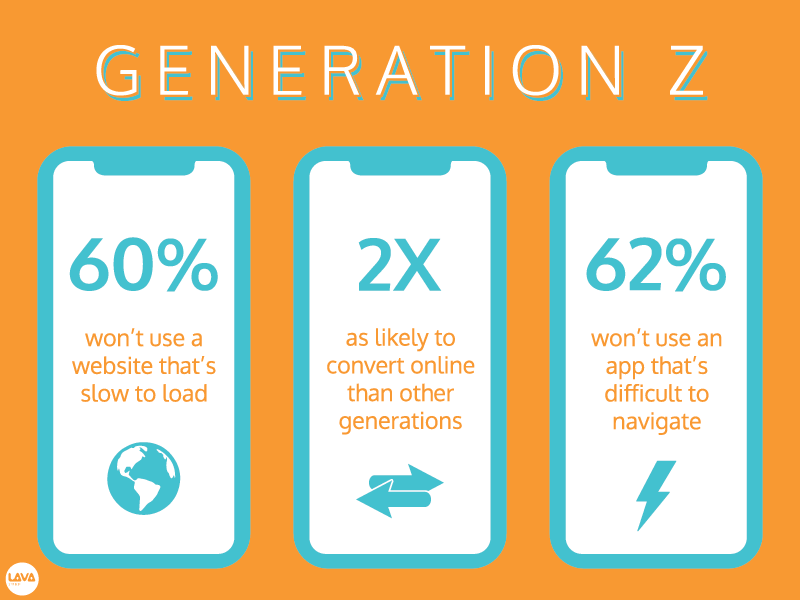
Stats of Gen Z ways of engaging with a business website or an app
To connect with Gen Z, businesses require a shift from one-size-fits-all Gen Z marketing strategies to a targeted approach that resonates with their unique values, and media consumption habits, and is formal towards traditional advertising.
What is the Purpose of Gen Z Marketing?
The purpose of Gen Z marketing is very crucial to be understood by business owners to reach their highest potential customers. Here are two main purposes to discuss:
Brand Awareness and Loyalty: Build brand awareness and establish long-term loyalty among Generation Z consumers. This generation has immense spending power and will be a dominant force in the marketplace for years to come.
Boost Sales and Conversions: Drive sales and conversions by crafting marketing campaigns that resonate with Gen Z’s needs and desires. They are highly receptive to authentic messaging and brands that align with their values.
Why do Businesses need to Master Gen Z Marketing?
Here’s why mastering Gen Z marketing is crucial for businesses:
Addressing low engagement rates
Businesses often experience frustration over low engagement rates with Generation Z audiences. This is primarily due to a lack of understanding of Gen Z’s preferences for content and interaction. Mastering Gen Z marketing involves creating compelling, relevant content that resonates with their interests and values.
Capitalizing on Potential Business Opportunities
There is a significant fear of missing out on potential business opportunities with this demographic. Generation Z represents a substantial and growing segment of the consumer market, with increasing purchasing power. Ignoring this group means potentially losing out on a large customer base that could drive future growth.
Staying Competitive
Businesses also face anxiety about falling behind competitors who successfully target Generation Z. Companies that excel in Gen Z marketing can build stronger brand loyalty and achieve better market positioning. Staying ahead requires adopting innovative marketing strategies tailored to the unique characteristics of Gen Z.
How did Gen Z Break the Marketing Funnel?
Traditional marketing funnels follow a straightforward path: from awareness to consideration, and finally to purchase. However, Gen Z doesn’t follow this predictable journey. They engage with brands in a more dynamic and unpredictable way.
Below are the ways in which Gen Z broke the marketing funnel.
Non-Linear Engagement
Instead of moving step-by-step, Gen Z interacts with brands through multiple channels simultaneously. They might discover a brand on Instagram, read reviews on a blog, and purchase a mobile app, all in a short span of time.
Immediate and Personalized Experiences
Gen Z wants quick, tailored experiences. They expect brands to know their preferences and to deliver relevant content and offers instantly. If a brand fails to meet these expectations, they won’t hesitate to switch to a competitor.
Continuous Engagement
For Zoomers, the relationship with a brand doesn’t end after a purchase. They expect ongoing interaction, whether through social media, emails, or new content. This continuous engagement creates a cycle of feedback and loyalty, rather than a one-time transaction.
Cyclical Marketing Funnel
Think of the Generation Z marketing funnel as a loop rather than a straight line. Zoomers move fluidly between stages of awareness, consideration, purchase, and post-purchase engagement, often revisiting each stage multiple times. Brands must be prepared to engage with Gen Z at any point in this cycle, providing consistent and meaningful interactions.
Marketing Facts and Statistics About Gen Z
The below-mentioned statistics and facts are gathered from Hootsuite, EMARKETER, Statista, and other sources.
“Gen Z shoppers are more likely to find new things on brand websites than on third-party shopping websites and apps. They are also more careful and less inclined to make unplanned purchases than previous generations.”
60% of Zoomers users shop online via email, and 53% have made purchases on their phone or tablet in the last six months. When purchasing online, 65% of Gen Z shoppers prefer not to see things that have sold out.
83% of Gen Z shoppers use social media, and 97% say it is their primary means of investigating buying alternatives. Social media, especially influencers and display ads, is the primary way for Gen Zers to learn about new products.
In 2023, 94% of Generation Z streamed videos, with 71% watching them on mobile cell phones. YouTube is the most popular platform among Gen Zs, followed by TikTok and Instagram.
“67% of Zoomers like to see actual people in advertisements, while 54% want to control what information they share about themselves. Therefore, they like brands that stress social values and the environment. 73% of Generation Z only purchases from brands they believe in.“
How do I Reach Gen Z?
Authenticity is Key: Gen Z craves authenticity. They see through inauthentic marketing and value brands that stand for something bigger. Be transparent, and purpose-driven, and show your true personality.
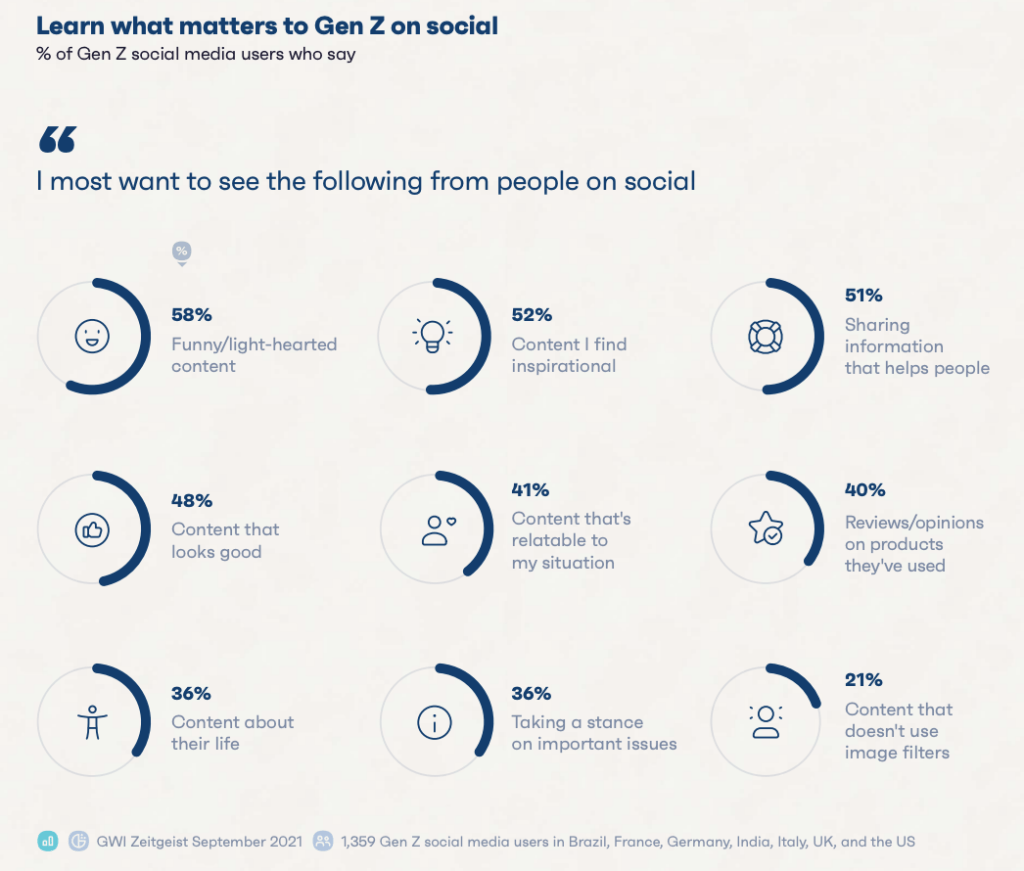
Embrace social media: This is where Gen Z lives. Focus on platforms like TikTok, Instagram, and YouTube with short-form video content, user-generated content (UGC) campaigns, and influencer partnerships.
Become an Entertainer: Gone are the days of dry, promotional content. Create engaging, informative, and entertaining content that adds value to Zoomers’ lives. Make them laugh, educate them, or inspire them.
Mobile Optimization: With this generation predominantly using mobile devices, ensuring your website and content are mobile-friendly is essential. Fast loading times, easy navigation, and a mobile-responsive design are key factors.
Gen Z Marketing Strategies for Businesses
There are the top 5 Gen Z marketing strategies for businesses to reach the minds of Zoomers. Let’s have an overview.
Micro-Influencer Marketing: Partner with relevant micro-influencers who have a genuine connection with Gen Z audiences. These partnerships are more authentic and impactful than celebrity endorsements.
Interactive Content: Leverage interactive content formats like polls, quizzes, and contests to drive engagement and brand recall.
Community Building: Create a community around your brand. Foster dialogue, encourage user-generated content and build genuine relationships with your Zoom audience.
Embrace Social Responsibility: Generation Z cares deeply about social causes. Highlight your brand’s commitment to sustainability, social justice, and ethical practices.
Personalization: Use data analytics to deliver personalized experiences. Tailored recommendations, personalized emails, and targeted ads resonate more with 1997–2012 consumers.
Gen Z Marketing Trends for 2025
Zoomers’ influence as a consumer force is undeniable. To stay relevant and capture their attention, businesses need to adapt their marketing strategies, along with some Gen Z marketing trends to watch in 2025.
Social Commerce: Livestream shopping and interactive shoppable content will continue to gain traction, especially on platforms like TikTok and Instagram.
Augmented Reality (AR) Marketing: AR experiences will be used to showcase products, engage customers, and create a more immersive shopping experience.
Focus on Mental Wellness: Mental wellness issues are a growing concern for Gen Z. Partner with mental health organizations or create content that promotes positive mental health practices.
Short-Form Content: Temporary content, which disappears after a short period, such as Instagram Stories and Snapchat, creates a sense of urgency and exclusivity, appealing to Gen Z’s FOMO (fear of missing out).
Wrapping Up!
By understanding these Gen Z marketing strategies and trends, you can overcome the pain points of low engagement, fear of missing out and falling behind competitors. You’ll be well on your way to building a strong connection with the powerful Gen Z audience and unlocking the immense potential of this generation.
To read more insights and guides about marketing and technology trends, visit our resources page. See you again with another hottest trend. Stay Tuned!
Frequently Asked Questions (FAQs)
1. What is Gen Z marketing? Gen Z marketing focuses on strategies tailored to appeal to individuals born between 1997 and 2012, emphasizing authenticity, digital engagement, and inclusivity.
2. Why is Gen Z important to marketers? Gen Z represents a growing consumer base with significant spending power and influence on market trends.
3. How does Gen Z differ from Millennials in marketing preferences? Gen Z prefers short, authentic content, values social responsibility, and engages more with video platforms like TikTok and YouTube.
4. What role does social media play in Gen Z marketing? Social media is central to reaching Gen Z, as they spend significant time on platforms for entertainment, connection, and brand discovery.
5. What are effective strategies to engage Gen Z consumers? Use authentic storytelling, influencer partnerships, interactive content, and demonstrate your brand’s commitment to social and environmental causes.
The tech industry is evolving at breakneck speed, redefining how we work, live, and interact. As we’ve already stepped into 2025, several macro trends in tech industry are taking center stage. Artificial intelligence and Generative AI are at the top of the list. So, here’s the complete guide to help you uncover all the current macro trends.
What is the Meaning of Macro Trends in Tech?
Macro trends mean changes in innovation and growth which influence the larger part of any industry. In context, such top tech trends bring shifts at larger-scale.
Why You Should Be Well-Versed About Macro Tech Trends?
Have you heard or seen crystal balls? Global macro trends are similar to crystal ball, it helps industries predict the future of the upcoming innovation. This helps you…
Stay relevant by aligning your skills with the latest advancements in the tech industry.
Stand out by using emerging technologies and staying at the top of market trends.
Use knowledge of macro trends to guide investments, strategies, and innovations.
Meet evolving demands by integrating cutting-edge solutions like AR/VR or AI.
Play a role in tackling global challenges with sustainable and impactful tech solutions.
Top Global Macro Trends in Tech to Watch Out in 2025
Artificial Intelligence and Gen AI
Artificial intelligence continues to dominate, driving automation across industries. Businesses use AI to streamline operations, enhance customer experiences, and reduce costs. Machine learning, natural language processing, and AI-driven analytics enable smarter decision-making and predictive insights.
AI allows businesses to operate more efficiently, reduce human error, and innovate faster.
Edge computing brings data processing closer to its source, reducing latency and improving performance. With the rise of IoT devices, this technology ensures faster response times and enhanced security.
Applications: Edge computing is crucial for autonomous vehicles, smart factories, and healthcare monitoring systems.
Polyfunctional Robots
In 2025, Polyfunctional robots will be revolutionizing industries by performing multiple tasks within a single unit. These robots adapt to various environments and seamlessly switch between functions, driven by AI and advanced sensors.
Key Features:
Adaptability: Perform diverse tasks, from manufacturing to healthcare.
Cost-Effectiveness: Replace the need for multiple specialized devices.
AI Integration: Learn and improve over time through machine learning.
Real-World Applications:
Healthcare: Assisting in surgeries and diagnostics.
Retail: Managing inventory and customer interactions.
Defense: Conducting surveillance and rescue operations.
Polyfunctional robots exemplify how technology pushes boundaries, making life easier and more efficient.
Ambient Invisible Intelligence
Imagine a world where technology operates seamlessly in the background—this is the promise of ambient invisible intelligence. Combining AI, IoT, and sensors creates a proactive environment that enhances everyday experiences without users needing to lift a finger.
Key Features:
Ubiquity: Embedded in devices and infrastructure for omnipresent functionality.
Proactive Assistance: Anticipates needs through real-time data analysis.
Sustainability: Optimizes energy and resource usage.
Real-World Applications:
Smart Homes: Automated systems for lighting, security, and climate control.
Healthcare: Non-invasive patient monitoring and timely alerts.
Urban Planning: Smart cities optimizing traffic and resource management.
Synergy Alert: When combined with polyfunctional robots, ambient invisible intelligence creates a powerful ecosystem where robots interact seamlessly with their surroundings, offering unprecedented efficiency and personalization.
The focus on sustainability has never been stronger. From energy-efficient devices to eco-friendly manufacturing, technology is aligning with environmental goals to combat climate change.
Examples: Renewable energy solutions, biodegradable materials in hardware, and AI-driven resource optimization.
Web 3.0
Web 3.0 is shaping the future of the internet by decentralizing control and empowering users. With blockchain at its core, it ensures transparency, security, and greater autonomy for individuals online.
Impact: Transforming industries like finance, healthcare, and supply chain management with decentralized apps (dApps).
It’s a Wrap!
Adapting these top global macro trends in tech in year 2025 will help businesses in the tech industry stay on the track. Businesses can easily predict growth and change their strategies to make the right decision.
To stay updated on the latest micro or macro trends in different industries, subscribe to our newsletter. You can also go through our resourceful blogs to gain some knowledge.
Meanwhile, stay tuned for more upcoming insights curated for businesses like you.
Large language models have moved from research curiosities to production-grade systems. Key 2024–2026 shifts: mainstream multimodal models, wider adoption of retrieval augmented generation, the rise of agent and tool-using systems, and active model deprecation cycles. Update content to emphasize RAG, multimodality, model lifecycle, and clear dated citations.
This blog delves into the history of large language models, exploring their evolution and the milestones that have shaped generative AI.
What Are Large Language Models (LLMs)?
Before diving into the evolution of LLMs, let’s set the stage. Large language models are AI systems designed to understand and generate human language. They’re trained on massive datasets, learning patterns, context, and nuances to produce coherent and meaningful text.
These models have found applications in:
Chatbots and virtual assistants (for example, ChatGPT, Claude, Google’s Gemini)
You have understood the meaning of LLMs, now let’s have a short glimpse at which and when large language models were invented and for what purpose. Continue reading…
1. The Early Days: Rule-Based Systems
In the 1950s and 1960s, AI was in its infancy. Models like ELIZA (1966) used simple, rule-based approaches to mimic human conversations. While groundbreaking, ELIZA lacked understanding and relied on pre-programmed responses. It laid the foundation for the future of AI-powered communication.
2. Statistical Methods Take Over
The 1990s saw a shift towards statistical language models (SLMs). These models used probability and statistics to predict the likelihood of word sequences. They were the precursors to modern LLMs but were limited by smaller datasets and computing power.
Notable Development:
N-grams: A technique that models sequences of N words, providing more context than single-word predictions.
3. The Neural Network Revolution
The 2010s marked a turning point in the history of large language models. Neural networks, particularly deep learning models, began to dominate. They offered superior performance by mimicking the way human brains process information.
Word Embeddings (2013): Tools like Word2Vec captured word meanings by placing them in a multi-dimensional space.
Recurrent Neural Networks (RNNs): Improved the ability to handle sequential data, such as sentences.
4. The Era of Transformers
In 2017, Google introduced the Transformer architecture, which became the backbone of modern LLMs. Transformers revolutionized how AI models process information, allowing them to analyze entire text sequences simultaneously rather than step by step.
Key Milestones:
BERT (2018): Bidirectional Encoder Representations from Transformers enhanced understanding of context by reading text in both directions.
GPT (2018): OpenAI’s Generative Pre-Trained Transformer introduced a model focused on generating coherent text, evolving into GPT-3 and GPT-4.
5. Generative AI Takes Center Stage
From 2020 onward generative models (GPT-3, GPT-4, Claude, Gemini, Llama families) moved into mainstream use. By 2024–2026 the focus shifted from parameter counts alone to capability: multimodality (text + images + audio), retrieval-augmented generation (RAG) for accuracy, and tool/agent integrations for automating multi-step tasks. Vendors released successive model families (Anthropic’s Claude 3 family, Meta’s Llama 3.x, and ongoing OpenAI updates), and production teams adopted RAG to keep answers timely and grounded. See Anthropic and Meta releases for reference.
How Are Large Language Models Transforming the World?
The impact of LLMs is far-reaching. They’re transforming industries by making processes faster, smarter, and more intuitive:
Healthcare: Automating documentation, summarizing patient records, and generating clinical drafts (with human review)
Education: personalized tutoring, content summaries, and assistance for different learning styles
Business: customer support automation, sales enablement, and knowledge-base query systems (RAG architectures keep corporate knowledge current).
LLMs are transforming other industries as well and making tasks easier and effective.
Which LLM is the Most Advanced Today in AI?
Rather than a single “most advanced” model, 2026 looks like a multi-leader landscape: OpenAI, Anthropic, Google, and Meta all offer high-capability models with different strengths. OpenAI’s ChatGPT family continues to lead in broad consumer adoption (major reporting in early 2026 placed weekly active users in the hundreds of millions).
Anthropic’s Claude 3 and subsequent Claude 3.5 iterations emphasize instruction-following and safety, while Meta’s Llama 3.x family provides powerful open-foundation options. Google’s Gemini and its integration with Search focus on retrieval and multimodal intelligence. Choose the model that best fits your needs, consider multimodality, latency, safety guardrails, cost, and provider lifecycle policies.
Challenges in the Development of Large Language Models
Despite their capabilities, LLMs come with challenges, after all nothing is perfect. Let’s see whether these challenges will be eliminated soon or remain to challenge the industry.
Bias & fairness — models can reproduce or amplify biases present in training data; active mitigation is required.
Hallucinations — models may confidently generate incorrect facts; RAG patterns and verification reduce this risk.
Compute & cost — training and running large models is resource-intensive; efficient inference and hybrid architectures matter.
Data privacy & compliance — handling sensitive or private data requires strict controls, redaction, auditing, and governance.
Model lifecycle — providers update and sometimes deprecate models; design systems to be model-agnostic and test replacements before switching.
What’s the Future of Large Language Models?
The future of large language models lies in greater personalization, multimodal capabilities (processing text, images, and audio), and enhanced ethical safeguards. Models like Gemini are pushing boundaries by integrating real-world reasoning into their AI systems.
It’s a Wrap!
The evolution of large language models is an inspiring story of innovation and discovery. As we move forward, these models will continue to redefine how we interact with technology and the world around us. Whether you’re a tech enthusiast or a professional understanding the history of large language models is your ticket to the future.
Therefore, check out our other insightful blog posts and subscribe to remain up-to-date on trends and innovation.
The video game industry has always been at the forefront of technological advancements, constantly pushing the boundaries of what is possible in digital entertainment. In recent years, one of the most significant innovations that have taken place is generative AI in the gaming industry.
Generative AI or Gen AI, also known as procedural generation, involves using algorithms to create dynamic and ever-changing content, such as game levels, characters, and narratives.
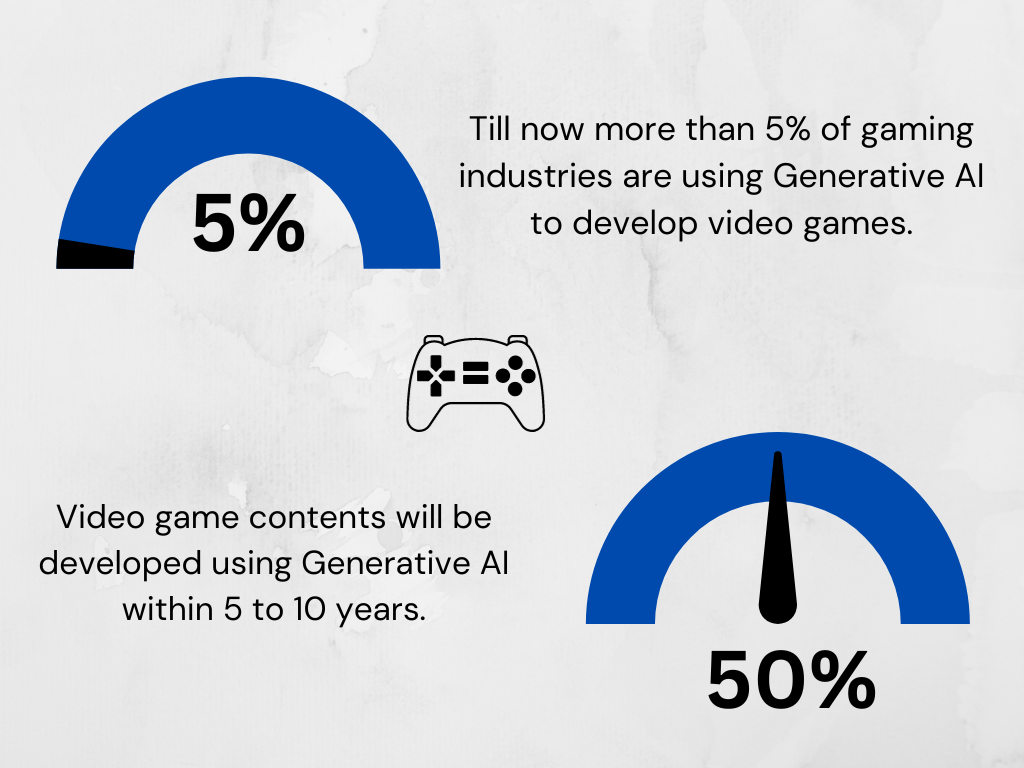
According to Bain & Company report, nowadays gaming industry is utilizing generative AI to create content for their games. Also, in the coming years, generative AI will take up a huge space in the industry, making it easier for creators to launch a masterpiece in less time and effort. So, the big question is…!!!
What are the Benefits of Generative AI in the Gaming Industry?
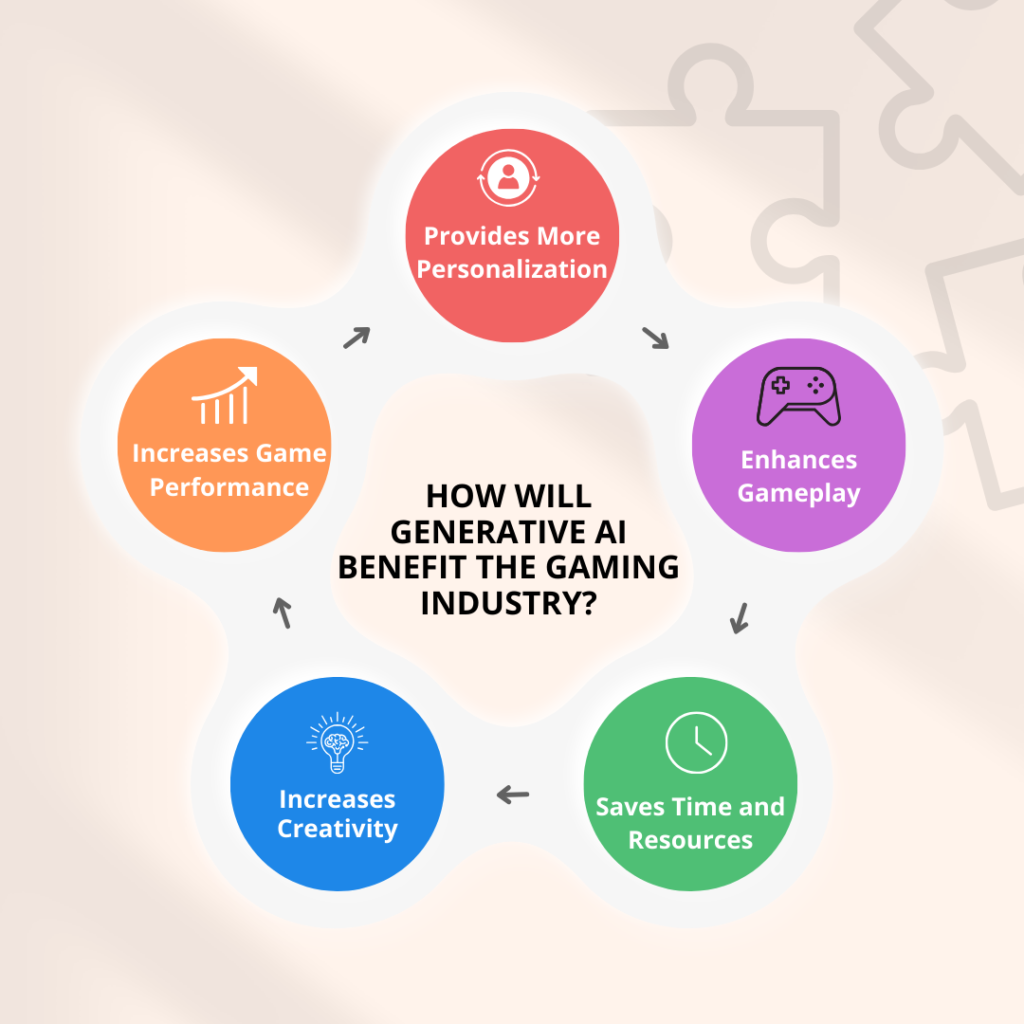
Traditionally, game developers painstakingly create every aspect of their games, from the level design to the dialogue, which can be a time-consuming and costly process. However, with the advent of gen AI, developers now have a powerful tool at their disposal to automate and streamline the content creation process. This not only saves time and resources but also allows for the creation of more dynamic and engaging games.
One of the most significant ways that how Gen AI in game development has changed is in the creation of game levels. Traditionally, designing levels required substantial manual labor and artists spent countless hours crafting every detail.
However, developers can now create unique and procedurally generated levels that offer players a fresh and unpredictable experience every time they play. This not only adds replay value to games but also allows developers to create larger and more complex worlds that would be impossible to design manually.
Not only does generative AI assist with game-level design, but it also has a profound impact on character creation. In the past, creating believable and lifelike characters required animators and artists to carefully handcraft every movement and expression.
With generative AI, developers can now use algorithms that analyze facial expressions, body movements, and speech patterns to generate characters that are truly realistic and nuanced. This technology has allowed for the creation of more immersive and emotionally engaging games, where players can connect with characters on a deeper level.
Another area where generative AI in the gaming market has brought significant advancements in creating dynamic and compelling narratives. Traditionally, game narratives followed a linear path, with limited player agency and little variation in storytelling.
However, with generative AI, developers can now create branching storylines that respond to player choices and actions. This allows for more immersive and personalized gameplay experiences, where players feel like their choices truly matter and have a direct impact on the outcome of the game.
Generative AI in game development also has the potential to revolutionize the way games are developed and tested. With the ability to generate vast amounts of content automatically, developers can quickly prototype and iterate on game ideas, saving both time and costs.
Therefore, gen AI can be used to simulate and test different game scenarios and player behaviors, helping developers identify and fix potential issues before the game is released.
What Gaming Executives are talking about Generative AI?
According to Bain & Company, they surveyed 25 gaming executives to have an overview of the impact of generative AI. They found that 20% of executives believed it would reduce development and the rest 80% did not expect it can impact talent & didn’t help alleviate the shortage of talent.
However, many responders believe that it will decrease game developers’ heavy-loaded tasks but also won’t be able to eliminate creative sparkle.
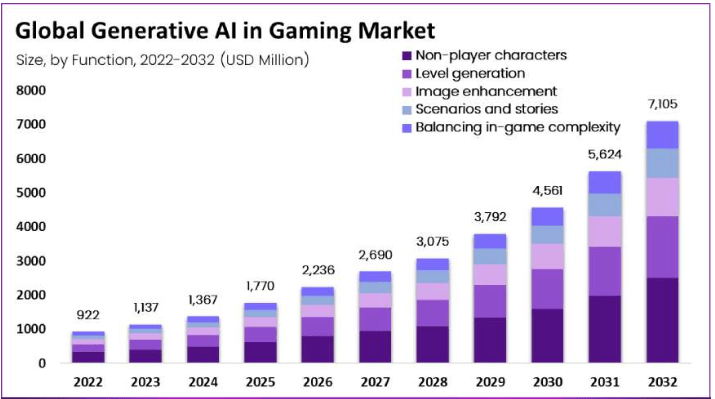
A Comprehensive Forecast of Generative AI in Game Development
If this new innovative technology has the potential to comprehensively transform the gaming industry then what will be the market in coming years? Below is the forecast for Gen AI in the Gaming industry.
The integration of cutting-edge technologies has become a defining factor for success. One such groundbreaking innovation that has taken the industry by storm is Gen AI. Gaming companies worldwide are leveraging the capabilities of Generative AI in game development to create immersive and dynamic experiences that push the boundaries of creativity and interactivity.
Ubisoft
Ubisoft, a leading player in the gaming industry, has embraced AI to enhance procedural content generation in their games. By utilizing algorithms that dynamically generate in-game content, such as environments, levels, and even narrative elements, Ubisoft can deliver vast and diverse gaming worlds. This not only reduces development time but also ensures a more engaging and unpredictable experience for players.
Electronic Arts
Electronic Arts (EA) has been at the forefront of incorporating Gen AI into its games, particularly in the realm of adaptive artificial intelligence. Through machine learning algorithms, EA’s games can adapt to the player’s style, learning from their decisions and behaviors. This personalized gaming experience ensures that players face unique challenges tailored to their skills and preferences, adding a layer of individualization to the gaming journey.
Epic Games
Epic Games, the creators of the widely used Unreal Engine, have been actively integrating AI into their development tools. Unreal Engine’s MetaHuman Creator, powered by Gen AI, allows developers to craft incredibly realistic and diverse character models with unprecedented speed and precision. This not only streamlines the character design process but also opens up new possibilities for creating lifelike and emotionally resonant characters in games.
Square Enix
Square Enix has delved into the realm of AI-driven storytelling, using Gen AI to dynamically shape narrative experiences. By employing machine learning to analyze player choices and behaviors, Square Enix can tailor the unfolding story in real-time, offering players a more responsive and personalized narrative journey.
Final Verdict!
As we witness the continuous evolution of generative AI in gaming, it stands as a testament to the industry’s commitment to pushing creative boundaries and delivering unparalleled gaming experiences.
To know more about how gen AI is impacting other industries, head over to our blogs and also subscribe to us for quick updates.
Frequently Asked Questions (FAQs)
How does Gen AI work? Gen AI uses machine learning models, such as neural networks, to analyze vast datasets and create content, simulations, and interactions autonomously, mimicking human creativity and decision-making.
What games use generative AI? Games like Minecraft, No Man’s Sky, and The Sims leverage generative AI for procedural world-building, dynamic storytelling, and realistic character behavior.
Which AI tool is used in gaming? Popular AI tools in gaming include Unity ML-Agents for machine learning, OpenAI’s GPT models for natural language processing, and procedural generation tools like Houdini for world-building.
What is the future of AI in gaming? The future of AI in gaming lies in creating more immersive, adaptive worlds with personalized player experiences, dynamic narratives, and lifelike AI-driven characters that evolve based on player interactions.
Today, small businesses are prime targets for cyber threats. As technology evolves, so do the methods cybercriminals use to exploit vulnerabilities. From healthcare to real estate, no industry is immune. This blog will explore the top cybersecurity threats for small businesses and provide actionable solutions to safeguard your operations.
Let’s dive in and understand how businesses can stay one step ahead of cybercriminals in 2025!
Why Small Businesses Are Targets of Cyber Threats?
Small businesses often lack the resources to implement robust cybersecurity measures, making them easy prey for cybercriminals. Hackers know that these businesses handle sensitive data yet often underestimate the need for advanced protection.
“Recent statistics reveal that small businesses are a primary target for cyberattacks, accounting for approximately 43% of all incidents affecting companies with fewer than 1,000 employees. Common threats include phishing scams, ransomware, and data breaches.
Unfortunately, many small businesses lack adequate cybersecurity measures, making them highly susceptible to these risks. Alarmingly, 60% of small businesses may face closure within 6 months of experiencing a significant cyberattack.”
Top Cybersecurity Threats for Small Businesses in 2025
Do you know? A staggering 78% of small business owners worry that a breach could force them to shut down. This highlights the urgent need for strong cybersecurity measures and financial safeguards. As malware is the common cyber threats attacked by a hacker, here are the other biggest cybersecurity threats for small businesses to watch out…
1. Ransomware Attacks
Ransomware attacks lock businesses out of their systems until a ransom is paid. Industries like healthcare and education, which rely heavily on uninterrupted access to data, are particularly vulnerable.
Example: A healthcare provider was forced to pay a hefty ransom when patient records were encrypted by attackers.
2. Phishing Scams (Don’t Take the Bait)
Phishing scams remain one of the biggest cybersecurity threats for small businesses. Fake emails and messages trick employees into revealing sensitive information like passwords and financial data.
3. Weak Password Policies (A Gateway for Hackers)
Using weak or reused passwords is like leaving your front door wide open for cybercriminals. High-tech industries like aerospace and defense often face targeted attacks exploiting this vulnerability.
4. Malware Attacks (Unseen Invaders)
Malware, including viruses and spyware, can infiltrate systems and steal or corrupt data. Real estate and finance sectors are increasingly targeted due to the sensitive financial transactions they handle.
5. Insider Threats (The Enemy Within)
The other top cybersecurity risk faced by small business is insider threats. This threat disgruntles employees or unintentional mistakes done by staff can lead to data breaches. Industries like education and automotive are at risk, where access to sensitive data may not always be tightly controlled.
Internet of Things (IoT) devices have become indispensable in industries like hitech and automotive. However, their security vulnerabilities can be exploited to access larger networks.
7. Cloud Security Misconfigurations (A Hidden Weakness)
Many small businesses store data in the cloud. A simple misconfiguration in cloud settings can expose critical data to unauthorized users.
8. Social Engineering (Manipulating Human Trust)
Cybercriminals use social engineering to manipulate employees into granting access to sensitive information. The entertainment and finance sectors often face this threat.
9. DDoS Attacks (Overloading Systems)
Distributed Denial of Service (DDoS) attacks overwhelm servers with traffic, rendering them inoperable. Small businesses in industries like real estate and entertainment are increasingly targeted.
10. Outdated Software (An Open Invitation)
Using outdated software creates vulnerabilities that hackers can exploit. Aerospace and defense industries, where precision is critical, face heightened risks from outdated systems.
Small businesses can’t afford to take cybersecurity lightly. Here are some practical steps to protect your business:
1. Invest in Cybersecurity Training
Your employees are often the first line of defense against cyber threats. Unfortunately, human error remains one of the leading causes of data breaches. By investing in cybersecurity training, you can equip your team with the skills and knowledge to recognize and respond to threats such as phishing emails, suspicious links, and malware.
Conduct regular workshops and seminars.
Simulate phishing attacks to test awareness.
Encourage a culture of vigilance by fostering open communication about potential risks.
Well-trained employees can act as a shield, preventing threats before they escalate.
“According to a recent study, 70% of employees engage in risky behaviors that jeopardize their company’s security. This underscores the critical importance of proper training to equip them with essential knowledge and skills.”
2. Use Firewalls and Antivirus Software
Basic security systems like firewalls and antivirus software are the foundation of a strong cybersecurity defense.
Firewalls monitor incoming and outgoing network traffic, blocking unauthorized access to your system.
Antivirus software detects and removes malicious programs that can compromise your data.
Ensure these tools are updated regularly to stay effective against the latest threats. Pair them with intrusion detection systems to bolster your defenses further.
3. Conduct Regular Security Audits
Imagine cybersecurity infrastructure as a house—regular inspections are necessary to ensure there are no weak spots. A security audit helps identify vulnerabilities in your system, such as outdated software, weak passwords, or unpatched security gaps.
Schedule audits at least quarterly.
Use third-party experts to gain an unbiased perspective.
By proactively addressing issues, you can stay one step ahead of cybercriminals.
4. Secure Your Network
Your business’s network is the gateway to its digital assets. Protecting this gateway is crucial:
Implement Virtual Private Networks (VPNs) to secure remote access and protect data in transit.
Use encryption to encode sensitive information, making it unreadable to unauthorized users.
Ensure all devices connected to the network are secure, including smartphones, laptops, and IoT devices.
Set up a robust password policy requiring complex passwords and multi-factor authentication (MFA).
A secure network minimizes the chances of unauthorized access, keeping your business safe from prying eyes.
5. Partner with Experts
Cybersecurity can be complex, and small businesses often lack the resources or expertise to handle it independently. Partnering with cybersecurity experts can bridge this gap.
Outsource your cybersecurity needs to managed service providers (MSPs).
Work with consultants to create a tailored security plan for your business.
Use 24/7 monitoring services to detect and respond to threats in real-time.
Experts can provide advanced solutions, like endpoint protection and threat intelligence, ensuring your business stays secure against evolving risks.
So, these were the top 10 cybersecurity threats for small businesses. By implementing the given expert-approved solutions, you can save your firm.
Safeguard Your Small Business with Top Cybersecurity Experts!
In conclusion, by recognizing the top cybersecurity risks faced by small businesses, you can develop a strong defense against potential threats.
Want to secure your small business against these threats? At The Expert Community, we offer the best cybersecurity solution to help you protect from above threats. Don’t wait for the breach to happen.
We use cookies on our website to give you the most relevant experience by remembering your preferences and repeat visits. By clicking “Accept”, you consent to the use of ALL the cookies.
This website uses cookies to improve your experience while you navigate through the website. Out of these, the cookies that are categorized as necessary are stored on your browser as they are essential for the working of basic functionalities of the website. We also use third-party cookies that help us analyze and understand how you use this website. These cookies will be stored in your browser only with your consent. You also have the option to opt-out of these cookies. But opting out of some of these cookies may affect your browsing experience.
Necessary cookies are absolutely essential for the website to function properly. These cookies ensure basic functionalities and security features of the website, anonymously.
Cookie
Duration
Description
cookielawinfo-checbox-analytics
11 months
This cookie is set by GDPR Cookie Consent plugin. The cookie is used to store the user consent for the cookies in the category "Analytics".
cookielawinfo-checbox-functional
11 months
The cookie is set by GDPR cookie consent to record the user consent for the cookies in the category "Functional".
cookielawinfo-checbox-others
11 months
This cookie is set by GDPR Cookie Consent plugin. The cookie is used to store the user consent for the cookies in the category "Other.
cookielawinfo-checkbox-necessary
11 months
This cookie is set by GDPR Cookie Consent plugin. The cookies is used to store the user consent for the cookies in the category "Necessary".
cookielawinfo-checkbox-performance
11 months
This cookie is set by GDPR Cookie Consent plugin. The cookie is used to store the user consent for the cookies in the category "Performance".
viewed_cookie_policy
11 months
The cookie is set by the GDPR Cookie Consent plugin and is used to store whether or not user has consented to the use of cookies. It does not store any personal data.
Functional cookies help to perform certain functionalities like sharing the content of the website on social media platforms, collect feedbacks, and other third-party features.
Performance cookies are used to understand and analyze the key performance indexes of the website which helps in delivering a better user experience for the visitors.
Analytical cookies are used to understand how visitors interact with the website. These cookies help provide information on metrics the number of visitors, bounce rate, traffic source, etc.
Advertisement cookies are used to provide visitors with relevant ads and marketing campaigns. These cookies track visitors across websites and collect information to provide customized ads.