Blockchain is one of the biggest buzzwords in the tech world today. It promises security, transparency, and efficiency, but is it the right choice for your business? Before diving in, it’s crucial to ask the right questions to ensure your investment is smart and profitable.
In this guide, we’ll break down the questions to ask before you invest in blockchain and explore why businesses should invest in blockchain (or why they shouldn’t). Let’s simplify this complex topic so you can make the best decision for your business!
1. What Problem Are You Trying to Solve?
Blockchain isn’t just a trend—it’s a solution. But does your business actually need it? Before investing, identify the specific problem blockchain will solve for you.
Example: If you run an e-commerce business and struggle with fraudulent transactions, blockchain’s secure ledger can help prevent fraud.
On the other hand… If you’re using it just because it’s “cool,” you might be wasting time and money.
Tip: Ask yourself: “ Is blockchain right for your business, Would blockchain truly improve efficiency, security, or cost savings for my business?” If the answer is unclear, you may not need it.
2. Is Your Industry Ready for Blockchain?
Blockchain is growing rapidly, but not every industry has fully adopted it. Some sectors, like finance, supply chain, and healthcare, are leading the way, while others are still catching up.
Industries That Benefit from Blockchain:
Banking & Finance – Reduces fraud and speeds up transactions. Supply Chain Management – Improves transparency and tracking. Healthcare – Protects patient data and prevents tampering. Real Estate – Simplifies property transactions and ownership records.
Example: If you own a logistics company, blockchain can help track shipments in real time. But if you run a small coffee shop, it may not be necessary.
Common Blockchain Costs: Hiring blockchain developers’ price Infrastructure setup and maintenance Compliance with security and legal regulations
Example: A global retail company might invest millions in blockchain to improve supply chain efficiency. But a small online store may find it too costly with minimal benefits.
Tip: Start small with a pilot project before committing fully.
4. Does Your Business Need Decentralization?
One of blockchain’s biggest benefits is decentralization, meaning no single entity controls the data. But does your business actually need this feature?
Who Needs Decentralization?
Businesses that require high transparency (e.g., voting systems) Companies dealing with sensitive data (e.g., financial institutions)
Example: If you run a peer-to-peer lending platform, decentralization can boost trust between users. But if you own a local retail shop, decentralization may not add much value.
5. What Are the Security Risks?
While blockchain is highly secure, it’s not 100% hack-proof. Some security challenges include:
Smart contract vulnerabilities – Hackers can exploit poorly written code. Private key management – Losing access to your key means losing funds. Regulatory risks – Governments are still figuring out blockchain laws.
Example: A cryptocurrency exchange must be extra cautious about hacking risks. But a real estate company using blockchain for contracts might have fewer concerns.
Tip: If security is your main concern, make sure to invest in strong cybersecurity measures along with blockchain.
Before making the leap, take a step back and ask yourself these six questions, think is blockchain right for your business? If blockchain aligns with your business needs, industry trends, and budget, it could be a game-changer. But if it seems unnecessary or too costly, it may be wise to hold off for now.
Key Takeaway: Blockchain isn’t for everyone—but for the right business, it can transform operations, boost security, and cut costs.
1. What are the main questions to ask before you invest in blockchain? You should consider cost, industry readiness, security risks, decentralization needs, and business benefits before investing.
2. Why businesses should invest in blockchain? Businesses invest in blockchain for better security, transparency, and cost savings, especially in finance, healthcare, and logistics.
3. Is blockchain worth the investment for small businesses? It depends! If blockchain solves a real problem in your business, it may be worth exploring. Otherwise, the costs may outweigh the benefits.
4. What industries benefit the most from blockchain? Industries like finance, healthcare, supply chain, and real estate see the biggest benefits from blockchain technology.
If you’re a designer, you must be well aware that creating user experience design is important for effortless interaction. Whether it’s an app or just a website, UX design is a not-to-be-ignored part. To help you understand better, we’ve curated this comprehensive guide with the following infographics.
Let’s delve deeper into the sea of designs…
What is User Experience Design?
UX design is all about making things better for users. It’s the process of transforming products, systems, or services that are functional and delightful to use.
Creating UX design bridges technology and human behavior, focusing on how users perceive, interact with, and feel about a product.
Let’s take a few examples to understand it better. For example smartphone apps like Instagram or TikTok. Their intuitive design and clear layout make it easy to find what we’re looking for.
Next, online shopping platforms like Amazon or Myntra offer a smooth shopping experience with features like personalized recommendations, easy checkout, and clear product information.
Last, smart home devices like Alexa and Google Home are designed to be user-friendly, responding to voice commands and learning your preferences over time.
Why does User Experience Design Matter?
Before delving into the intricacies of UX design, it’s essential to understand why creating user experience design is so important. In a world where users have countless options and limited patience, a positive user experience can be a game-changer for businesses and organizations. Here’s why:
User Satisfaction
When users have a pleasant experience with a product or service, they’re more likely to be satisfied. Satisfied users are not only more loyal but also more likely to recommend the product to others.
Improved Usability
A good user experience of the websiteensures that a website is easy to use, reducing the learning curve and frustration. Users can accomplish their goals effortlessly, whether it’s buying a product on the web or navigating through an app.
Increased Engagement
A well-designed user experience captivates users and keeps them engaged. This can lead to longer usage sessions and increased conversions, whether you’re running an e-commerce site or a mobile app.
Competitive Advantage
Users are more likely to choose a product that offers a superior experience over a clunky or confusing alternative.
Cost Savings
Investing in UX design upfront can save businesses money in the long run. It reduces the need for costly redesigns and support requests by addressing usability issues early in the development process.
Brand Loyalty
A positive user experiencecan foster brand loyalty. Users who have a strong emotional connection with a product or service are more likely to stick around and become long-term customers.
According to adamfard survey, even if 78% of businesses wants to offer best UX design still 45% of businesses fail to conduct UX design testing to ensure perfection of the product.
What is the Difference Between UI and UX Design?
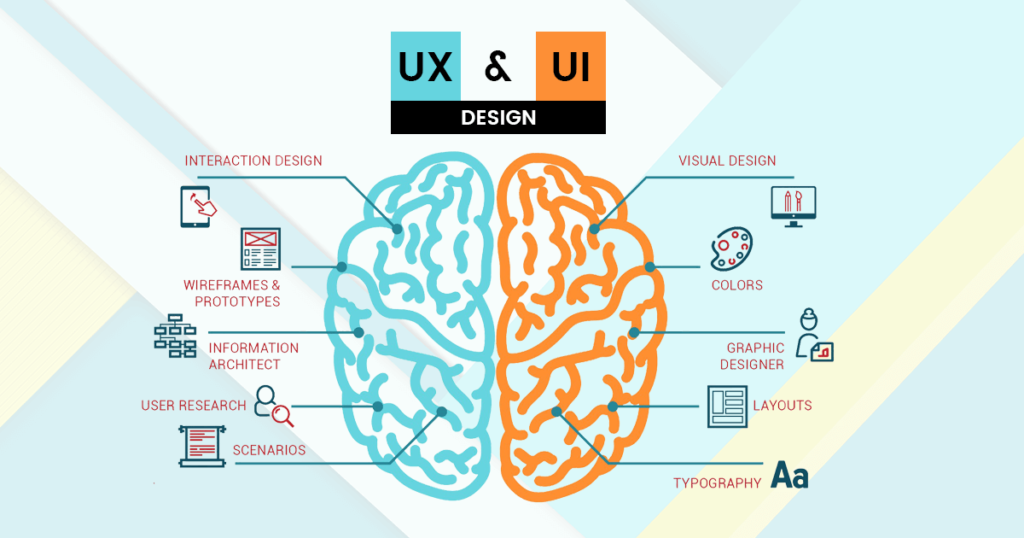
UX and UI design are two closely related terms that often get used interchangeably, but they have distinct meanings and roles in the design process.
Here’s a breakdown of the key differences between UX/UI design excellence:
Image Source: Bluebash
UX (User Experience)
Focuses on the overall experience a user has when interacting with a product or service. This includes everything from the initial impression to ongoing satisfaction and loyalty.
Involves research, analysis, and testing to understand user needs, motivations, and pain points.
Aims to create products that are usable, enjoyable, and efficient.
UI (User Interface)
Focuses on the visual and interactive elements of a product or service. This includes the layout, colors, typography, buttons, and other elements that users see and interact with.
Involves design and development to create an interface that is aesthetically pleasing, intuitive, and easy to use.
Plays a crucial role in shaping the overall user experience.
So, these were the core difference between UX/UI design excellence. Let’s now talk about benefits of user experience design.
What are the Core Benefits of Creating User Experience Design?
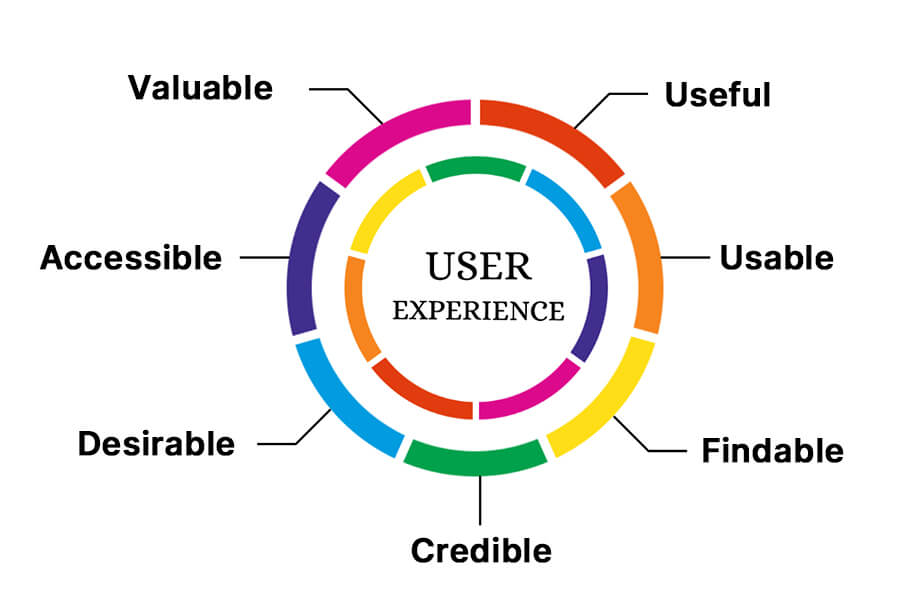
To create exceptional user experience design, designers adhere to a set of core principles. These principles guide the design process and ensure that the end product aligns with user needs and expectations:
Image Source: neetable.com
User-Centered Design
The user is at the center of everything in UX design. Expert UX Designers conduct extensive research to understand user needs, behaviors, and pain points. This research informs the design decisions at every stage.
Usability
Usability is about making products easy to use. It involves clear navigation, intuitive interfaces, and minimizing cognitive load for users. When something is usable, it means users can achieve their goals efficiently.
Consistency
Consistency in design creates a sense of familiarity. Users should find similar patterns and elements throughout a product or website, which makes it easier for them to navigate and understand.
Accessibility
Accessibility ensures that a product is usable by people with disabilities. This principle emphasizes the importance of inclusivity and making technology accessible to everyone, regardless of their abilities.
Simplicity
“Simplicity is the ultimate sophistication.” This principle encourages designers to keep things simple and avoid unnecessary complexity. Simplified designs tend to be more user-friendly.
What is the Process of User Experience Design?
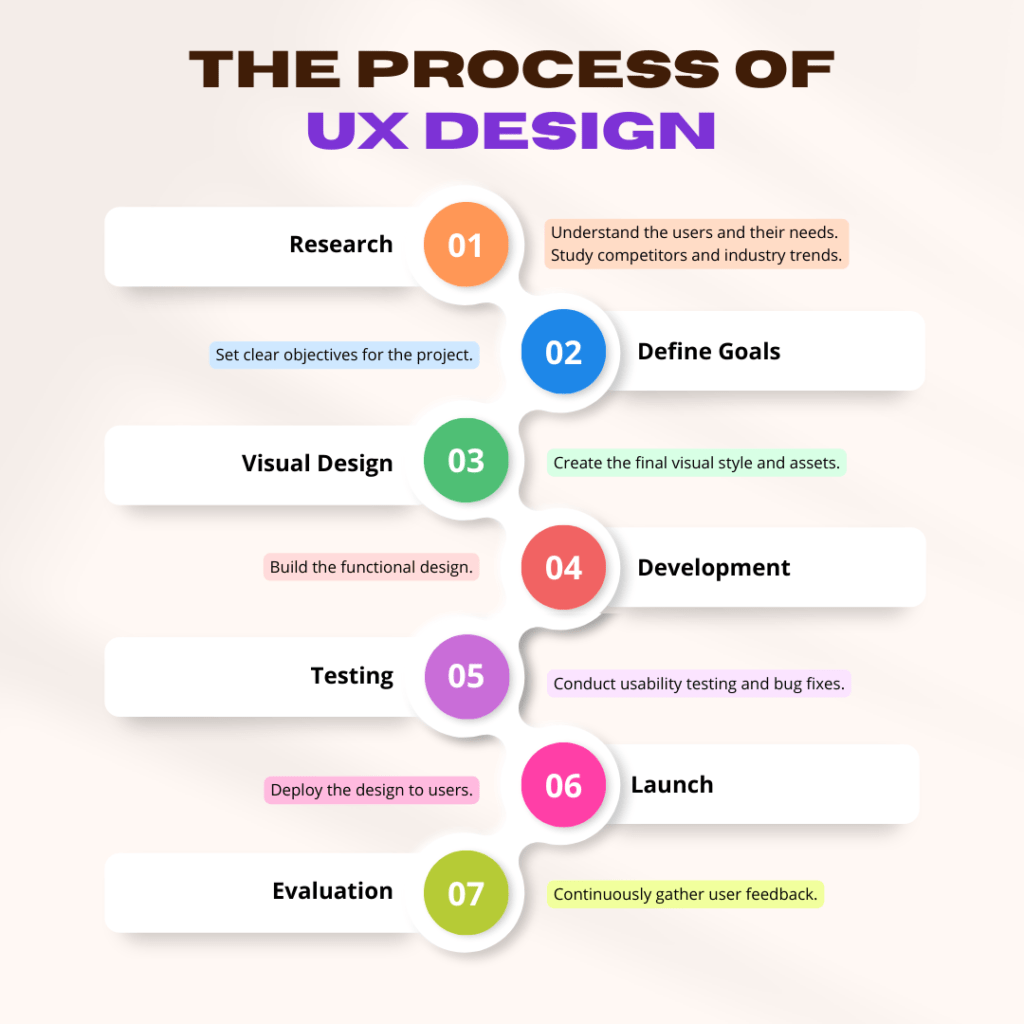
User experience design is not a one-time task but an ongoing process. The process typically involves several stages:
Research The first step is to understand the users and their needs. This involves user interviews, surveys, market analysis, and competitor research. The goal is to gather insights that inform the design.
Planning Once you have a clear understanding of users, it’s time to plan the design. This stage includes defining goals, creating user personas, and outlining the user journey.
Design Design is where the magic happens. Designers create wireframes, prototypes, and visual designs based on the research and planning. This stage often involves iterative testing and refinement.
Development Once the design is finalized, it moves to the development phase. Developers bring the design to life, ensuring that it’s functional and meets technical requirements.
Testing Testing is crucial for identifying any issues or usability problems. User testing, A/B testing, and usability testing help ensure that the design meets user expectations.
Launch After thorough testing and refinement, the product is ready for launch. This is when it becomes available to users.
Post-Launch Evaluation The design process doesn’t end at launch. Continuous evaluation and improvement are essential. Feedback from users helps identify areas that can be enhanced.
What Tools Should a UX Designer Use?
UX expert designers use various tools to streamline the design process and create user-friendly experiences. Here are some commonly used types of user experience tools and names:
Wire-framing and Prototyping Tools
Usability Testing Tools
Analytics Tools
Collaboration Tools
Future of User Experience Design
The future of UX Design is an exciting frontier that promises to transform the way we interact with technology. Here is the future of creating user experience design…
Voice User Interfaces, for instance, is gaining prominence with the surge in smart speakers and voice assistants, creating a need for designers to craft seamless voice interactions.
Augmented Reality (AR) and Virtual Reality (VR) are pushing the boundaries of immersive experiences, from gaming to education and beyond. Next, Ethical design is also taking center stage, with a growing emphasis on user well-being, data privacy, and responsible AI use.
In addition, AI and machine learning are becoming integral to the design process, providing personalization and recommendations that enhance user experiences.
Therefore, the future is not just about making things easier to use; it’s about crafting meaningful, ethical, and personalized interactions in a rapidly evolving digital landscape.
Conclusion
Creating user experience design is about understanding users, addressing their needs, and making technology work seamlessly for them. So, whether you’re designing an app, a website, or any digital product, remember that UX design is the secret sauce that can turn users into loyal fans.
Do you want to create your future with just a click? Contact our UX designers to provide you with high-end UX-designed innovations that have the full potential to transform your startup into a big brand.
What are the 5 elements of user experience design?
Strategy
Scope
Structure
Skeleton
Surface
What is UX design with examples?
User Experience (UX) design is a multidisciplinary approach focused on enhancing the overall experience that users have with a product, service, or system. It encompasses various aspects, including usability, accessibility, aesthetics, and the emotional impact of the user’s interaction.
UX design examples are:- website design, mobile app designs, product designs, software interface designs, and e-commerce platforms.
What are the 4 C’s of UX?
The 4C’s of UX design are:- Clarity, Consistency, Convenience, and Constraint. These 4 C’s help designers create user experiences that are not only aesthetically pleasing but also functional, intuitive, and aligned with user expectations. Incorporating these principles can lead to a more positive and effective user interaction with digital interfaces, products, or services.
Educational institutions store vast amounts of sensitive student data, making them prime targets for cyber threats. One such institution in Canada faced increasing cybersecurity risks due to outdated security measures and rising cyber threats. The cyber head of the institute contact us to assist them with the issues.
Therefore, we at The Expert Community team stepped in to with cybersecurity practices for educational institution and provided student data protection from potential breaches.
The Challenge
Data at Risk: A Growing Concern for an Educational Institution!
Our client, a well-established educational institution, faced growing cybersecurity concerns as their student data protection became vulnerable to potential breaches. Despite having a basic IT security framework in place, their outdated security protocols and lack of proactive monitoring left them exposed to cyber threats.
They encountered several critical challenges that required immediate attention:
Unsecured student records – Containing personal and academic data at risk of breaches.
Weak access controls – Staff and students had excessive permissions, increasing vulnerabilities.
Lack of threat monitoring – No real-time tracking of suspicious activities.
Compliance risks – Failing to meet evolving data protection regulations.
With the rise of ransomware attacks, the client needed a robust, scalable cybersecurity for their educational institution—and they needed it fast.
Fortifying Cyber Defenses with a Multi-Layered Approach!
Our cybersecurity experts conducted an in-depth risk assessment and implemented a multi-layered security approach tailored to the institution’s needs.
1. Strengthening Data Security
Data Encryption – We encrypted all student records, ensuring data remained secure even if accessed unlawfully. Access Control Management – Implemented role-based access controls, allowing only authorized personnel to access sensitive data.
2. Real-Time Threat Detection
AI-Powered Security Monitoring – Deployed a 24/7 cybersecurity monitoring system that detected and neutralized threats in real time. Incident Response Plan – Trained the institution’s IT team on rapid-response strategies in case of a cyber attack.
3. Compliance & Awareness Training
Regulatory Compliance – Ensured adherence to PIPEDA (Personal Information Protection and Electronic Documents Act) and other data protection laws. Cybersecurity Awareness Training – Educated staff and students on recognizing phishing attempts and securing their credentials.
The Outcome
From Vulnerable to Unbreakable: A Cybersecurity Success Story!
No security incidents after the implementation of our cybersecurity solutions.
The institution’s cybersecurity framework became 99% more resilient to attacks.
Successfully met all data protection and compliance standards.
Faculty and students became well-versed in cybersecurity best practices.
Final Verdict!
Secure Today, Safe Tomorrow—Protect Your Institution Now!
Cyber threats in the education sector are on the rise, but with the right cybersecurity for educational institution can safeguard sensitive data. Our team at The Expert Community provided a custom cybersecurity solution that not only protected the institution but also ensured long-term security resilience.
With the rapid advancement of telemedicine, a mid-sized healthcare clinic approached us to develop an innovative remote healthcare app. Their goal was to provide seamless remote healthcare access, enhance patient engagement, and streamline administrative processes.
The clinic faced challenges with long appointment wait times, inefficient patient record management, and limited accessibility for rural patients. We at The Expert Community provided an effective solution to solve the issue. Let’s dive into the client challenges, our solution, and final outcome in detail.
Challenges
Before approaching us, the clinic struggled with:
Limited Remote Accessibility – Patients, especially in rural areas, had difficulty accessing healthcare services.
Inefficient Appointment Scheduling – Long waiting times due to manual booking processes.
Lack of Real-Time Patient Monitoring – The absence of digital health tracking for chronic patients.
Data Security & Compliance – Ensuring patient data privacy while adhering to regulatory standards.
Our Approach
Step 1: Requirement Gathering & Market Analysis
We conducted in-depth discussions with the clinic’s medical team and surveyed patients to understand pain points. Our team also analyzed competitor remote healthcare apps to identify unique features that could set the clinic apart.
Step 2: Designing the User Experience (UX/UI)
Understanding that remote healthcare app require simplicity and clarity, we crafted a user-friendly interface with:
AI-Powered Symptom Checker – Helps users assess their symptoms before booking a consultation.
Secure Video Consultation – Enables remote doctor-patient interactions.
E-Prescription & Digital Health Records – Allows doctors to issue prescriptions digitally and store patient histories.
Automated Appointment Reminders – Reduces no-shows and optimizes scheduling.
Wearable Device Integration – Syncs with smartwatches to monitor vital health data in real time.
Step 4: Ensuring Security & Compliance
Data security was a primary concern. We implemented end-to-end encryption, two-factor authentication (2FA), and compliance with HIPAA regulations to protect sensitive patient data.
Step 5: Beta Testing & Deployment
We conducted extensive beta testing with a select group of patients and doctors to refine usability. After multiple iterations, the app was launched with a phased rollout strategy to ensure smooth adoption.
Results & Impact
35% Reduction in Wait Times – Patients could book appointments within minutes, significantly reducing congestion at the clinic.
50% Increase in Teleconsultations – More patients opted for remote consultations, improving accessibility for those in remote areas.
Enhanced Patient Satisfaction – Surveys showed an 80% satisfaction rate due to the app’s ease of use and accessibility.
Improved Operational Efficiency – The clinic saw a 40% reduction in administrative workload as appointment scheduling and record management became automated.
Key Takeaways
Simplicity and accessibility drove high adoption rates.
Adhering to compliance standards ensured data privacy and trust.
Intelligent features reduced manual workload and improved patient engagement.
By partnering with The Expert Community, the medical clinic transformed its patient care experience through a state-of-the-art remote healthcare app. The project not only resolved existing challenges but also positioned the clinic as a leader in digital healthcare innovation.
This case study highlights how the right blend of technology, security, and user-centric design can revolutionize remote healthcare access.
Technology is evolving at lightning speed, and businesses must keep up to stay ahead of the game. Digital transformation trends are changing how companies operate, connect with customers, and drive innovation.
So, what are the latest digital transformation trends that will dominate 2025? Let’s dive into the biggest game-changers you should watch out for!
#7 Latest Digital Transformation Trends for 2025
Let’s explore the 7 most impactful digital transformation trends that are shaping the future. Whether you’re a startup or an enterprise, staying ahead of these innovations will be the key to long-term success. Let’s dive in!
#7. AI and Machine Learning
Artificial Intelligence (AI) and Machine Learning (ML) are no longer just fancy buzzwords—they’re the backbone of modern businesses. These technologies help companies automate tasks, improve decision-making, and personalize customer experiences.
How AI and ML Are Transforming Businesses?
Smarter Chatbots: AI-powered chatbots provide 24/7 customer support, answering queries faster than ever.
Predictive Analytics: Businesses use AI to forecast trends, helping them make data-driven decisions.
AI in Healthcare: AI detects diseases early, leading to better treatments and patient care.
AI-powered tools like ChatGPT and Google Bard are making customer interactions smoother and more human-like.
The next digital transformation trends for 2025 are cloud and edge computing. Gone are the days of bulky servers. Cloud computing allows businesses to store, access, and manage data online, while edge computing processes data closer to where it’s created, reducing delays.
Why This Matters in 2025?
Faster Processing: Edge computing speeds up real-time decision-making.
Cost Savings: Cloud storage eliminates the need for expensive hardware.
Better Security: Data is safer with advanced encryption and security measures.
Netflix uses cloud computing to deliver seamless streaming experiences to millions of users worldwide.
#5. Connectivity and Networks
With 5G and advanced networks, the world is becoming more connected than ever. Businesses are utilizing high-speed internet to enhance digital experiences.
Key Benefits of 5G and Advanced Networks
Lightning-Fast Speed: Downloads and uploads are 100x faster than 4G.
Seamless Remote Work: Teams can collaborate in real time without lag.
Boost for IoT Devices: Smart homes and self-driving cars work more efficiently.
Smart cities use 5G to improve traffic management and public safety.
#4. Blockchain Technology
Blockchain is transforming industries by providing secure, transparent, and tamper-proof systems. While many associate it with Bitcoin, its applications go far beyond cryptocurrency.
How Blockchain Is Changing Businesses?
Secure Transactions: Banks use blockchain to prevent fraud.
Supply Chain Transparency: Companies track products from manufacturer to customer.
Walmart uses blockchain to track food safety and ensure fresh produce reaches consumers.
#3. Immersive Technologies
Augmented Reality (AR) and Virtual Reality (VR) are changing the way people interact with digital content. These technologies are widely used in gaming, shopping, and even job training.
Why Immersive Tech Is Booming?
Better Shopping Experiences: Customers try products virtually before buying.
Revolutionizing Education: VR-based learning makes education more interactive.
Workplace Training: Companies train employees in simulated environments.
IKEA’s AR app lets users visualize furniture in their homes before making a purchase.
#2. Digital Twins
A digital twin is a virtual replica of a physical object, system, or process. Businesses use digital twins to simulate real-world scenarios before making big decisions.
How Digital Twins Benefit Businesses?
Predictive Maintenance: Factories use digital twins to detect issues before breakdowns.
Smart Cities: Urban planners use digital twins to design efficient cities.
Healthcare Breakthroughs: Doctors practice surgeries on digital twin models.
Formula 1 teams use digital twins to simulate race car performance before hitting the track.
#1. Low-Code/No-Code Development
You no longer need to be a coding expert to create an app. Low-code and no-code platforms let anyone develop software using simple drag-and-drop tools.
Why This Trend Is Growing?
Faster Development: Apps are built in days, not months.
Cost-Effective: Companies save money on software development.
Empowers Everyone: Even non-tech people can create digital solutions.
Canva’s no-code platform allows users to design graphics without advanced skills.
As we enter 2025, the digital revolution is no longer a choice—it’s a necessity. The businesses that adapt, innovate, and evolve will lead the future, while those that hesitate risk being left behind. Will your company be a pioneer or a spectator?
Now is the moment to seize the opportunities, embrace the change, and future-proof your success. Start integrating these cutting-edge digital transformation trends today, because in the world of technology, tomorrow belongs to the bold.
Therefore, to stay up-to-date about latest trends and innovation in different industries, subscribe to our newsletter as well as explore insightful resources curated by the experts.
Frequently Asked Questions (FAQs)
1. What is the most important digital transformation trend for 2025?
AI and Machine Learning are the biggest drivers of digital transformation, revolutionizing industries with automation and predictive analytics.
2. How does blockchain contribute to digital transformation?
Blockchain enhances security, transparency, and efficiency in transactions, supply chains, and smart contracts.
3. What industries benefit the most from digital transformation?
Healthcare, finance, retail, manufacturing, and education are experiencing the most significant impact.
4. How can small businesses adopt digital transformation?
Small businesses can start by using cloud computing, automating tasks with AI, and utilizing low-code/no-code platforms for app development.
We use cookies on our website to give you the most relevant experience by remembering your preferences and repeat visits. By clicking “Accept”, you consent to the use of ALL the cookies.
This website uses cookies to improve your experience while you navigate through the website. Out of these, the cookies that are categorized as necessary are stored on your browser as they are essential for the working of basic functionalities of the website. We also use third-party cookies that help us analyze and understand how you use this website. These cookies will be stored in your browser only with your consent. You also have the option to opt-out of these cookies. But opting out of some of these cookies may affect your browsing experience.
Necessary cookies are absolutely essential for the website to function properly. These cookies ensure basic functionalities and security features of the website, anonymously.
Cookie
Duration
Description
cookielawinfo-checbox-analytics
11 months
This cookie is set by GDPR Cookie Consent plugin. The cookie is used to store the user consent for the cookies in the category "Analytics".
cookielawinfo-checbox-functional
11 months
The cookie is set by GDPR cookie consent to record the user consent for the cookies in the category "Functional".
cookielawinfo-checbox-others
11 months
This cookie is set by GDPR Cookie Consent plugin. The cookie is used to store the user consent for the cookies in the category "Other.
cookielawinfo-checkbox-necessary
11 months
This cookie is set by GDPR Cookie Consent plugin. The cookies is used to store the user consent for the cookies in the category "Necessary".
cookielawinfo-checkbox-performance
11 months
This cookie is set by GDPR Cookie Consent plugin. The cookie is used to store the user consent for the cookies in the category "Performance".
viewed_cookie_policy
11 months
The cookie is set by the GDPR Cookie Consent plugin and is used to store whether or not user has consented to the use of cookies. It does not store any personal data.
Functional cookies help to perform certain functionalities like sharing the content of the website on social media platforms, collect feedbacks, and other third-party features.
Performance cookies are used to understand and analyze the key performance indexes of the website which helps in delivering a better user experience for the visitors.
Analytical cookies are used to understand how visitors interact with the website. These cookies help provide information on metrics the number of visitors, bounce rate, traffic source, etc.
Advertisement cookies are used to provide visitors with relevant ads and marketing campaigns. These cookies track visitors across websites and collect information to provide customized ads.