AI in fashion: trends, limitations and what comes next
Fashion has always run on forecasting. A buyer orders stock months before anyone knows whether a colour or cut will sell, and the cost of a wrong guess shows up later as markdowns, unsold stock or empty shelves. That is why AI has found a natural home in the industry: most of its useful work is about making those guesses better.
Most of the attention goes to the visible parts: AI-generated campaigns, virtual try-on, chat-based stylists. The money tends to be in the less visible parts. McKinsey estimated in 2023 that generative AI could add between 150 and 275 billion US dollars to the operating profits of the apparel, fashion and luxury sectors within three to five years. Much of that comes from planning, product development and marketing, not from novelty features.
We first wrote this piece in 2024 and have updated it to reflect what has actually happened since.
Five places AI is changing fashion
1. Reading trends earlier
Trend forecasting used to rely on runway reports, trade fairs and a buyer’s instinct. Brands now add data to that mix: search volumes, social posts, resale prices and how new lines sell in their first week. Models pick up rising signals early, such as a silhouette that keeps appearing or a colour that starts selling out in one city.
The useful framing is “earlier”, not “certain”. A model can tell you a signal is rising; deciding whether to back it with a production run is still a judgement call.
2. Making the right amount of stock
This is where AI earns most of its keep. Demand forecasting models combine sales history with seasonality, promotions, weather and local events to estimate how many units of each size and colour each channel will sell. Better forecasts mean fewer markdowns, fewer stockouts and less unsold stock destroyed at the end of a season.
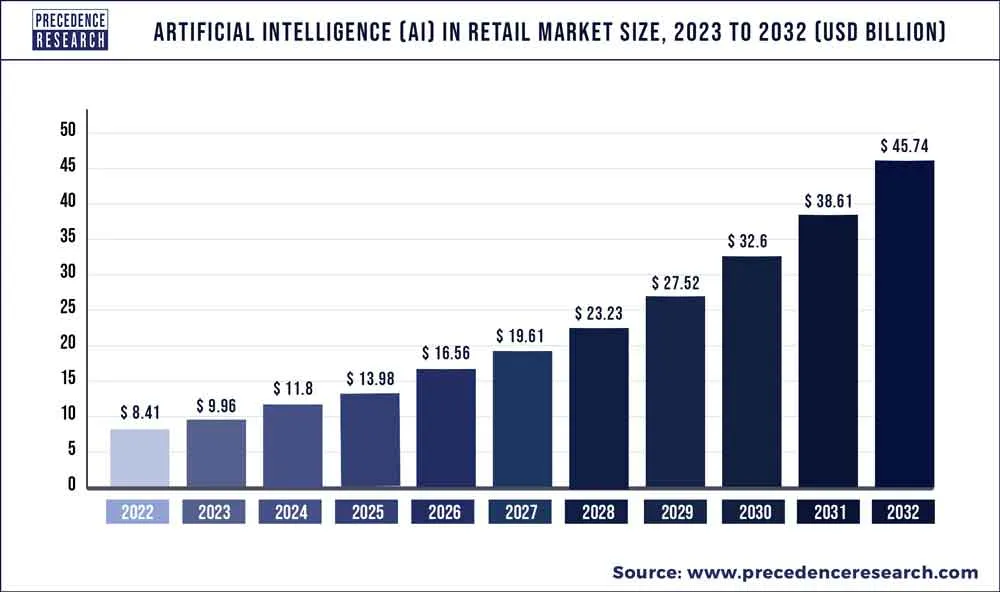
Forecast size of the AI in retail market, 2022–2032. Source: Precedence Research, 2023.
3. Personal recommendations
Online, the shop window can be different for every visitor. Recommendation models use browsing, purchase history and what similar shoppers bought to decide which products to show first. Stitch Fix built its business on this mix, pairing algorithms that shortlist items with human stylists who make the final selection. For most brands the practical version is simpler: better “complete the look” suggestions and emails that feature products a customer is likely to want.
4. Virtual try-on and fit
Returns are one of the largest costs in online fashion, and the most common reason is fit. Virtual try-on is now a mainstream answer to that. In May 2025 Google launched a try-on feature in Search that shows clothes on a photo of the shopper, building on its 2023 version that used a range of real models. Size recommendation tools, which learn from what shoppers kept and returned, often do as much for returns as visual try-on does.
5. Sustainability and circular fashion
Shoppers increasingly expect brands to show their environmental record, and regulators are following, especially on textile waste. AI helps in practical ways: sorting used garments for resale or recycling, matching surplus fabric with buyers, and, most of all, producing closer to real demand so less is made in the first place.
How fashion brands are using AI today
A few examples show the range:
- H&M announced in March 2025 that it would create AI “digital twins” of 30 models for some marketing, with the models’ consent and ownership of their likeness. The reaction was mixed, which says a lot about where the limits are.
- Levi’s said in 2023 it would test AI-generated models to show clothes on more body types, and faced criticism that it should hire diverse models instead. It’s a useful reminder that how you use AI matters to customers as much as whether you use it.
- Adidas and Nike use computational design and simulation to test materials and shapes before making physical samples, which shortens development cycles.
- Stitch Fix combines algorithmic shortlists with human stylists, as described above.
- Google brought virtual try-on to everyday shopping searches, which raises expectations for every brand’s own site.
Where AI falls short in fashion
It learns from the past. A model can only find patterns that already exist in its data. It’s good at telling you a trend is building; it can’t invent the next one. The designer’s eye is still the source of new ideas.
It repeats bias. If training data mostly shows one body type, skin tone or age, recommendations, imagery and size advice will serve that group best and everyone else worse. Brands need to test for this deliberately.
It raises questions of consent and trust. Generated models, synthetic photography and AI-written product copy can save time, but customers and the people whose likeness is used want transparency. H&M’s choice to give models ownership of their digital twins is one answer.
It depends on clean data. Many fashion businesses still keep product data across spreadsheets, a PLM system and an e-commerce platform that don’t agree on names, sizes or colours. No model fixes that. Getting product and stock data consistent is usually the first real step, and it pays off whether or not you use AI.
What comes next
Over the next few years, expect AI to move further into the operational heart of fashion businesses rather than the shop window: tighter links between what sells and what is produced, more made-to-order and small-batch production, and planning that updates weekly rather than seasonally.
Shopping will change too. As more people ask AI assistants for advice (“find me a linen jacket in my size that will arrive by Friday”), product data has to be complete and accurate enough for those assistants to understand. Brands with good product information will be recommended; brands with gaps will be skipped.
For most fashion businesses, the sensible first step is not a headline-grabbing feature. It’s a better forecast for your best-selling lines, built on data you already have. If you’re weighing where to begin, our retail industry page covers where we see AI paying off, and the AI Readiness Index gives you a quick read on whether your data is ready.
Ready to integrate AI into your retail or fashion business?
Connect with seasoned AI engineers and e-commerce developers on TEC to implement demand forecasting and smart personalization.
Hire E-commerce & AI ExpertsFrequently Asked Questions
How is AI used in the fashion industry?
Can AI predict fashion trends?
What are the disadvantages of AI in fashion?
Where should a smaller fashion brand start with AI?
Expert contributor sharing insights on AI, talent, and the future of work.